

What to Expect During Vasectomy Recovery
Vasectomy recovery is faster and easier than most men expect. Here is a quick overview:
| Phase | Timeline | What to Expect |
|---|---|---|
| Immediate | First 24 hours | Rest, ice, mild soreness, numbness fading |
| Early recovery | Days 2-3 | Light activity, return to desk work possible |
| Activity resumption | 1-2 weeks | No strenuous exercise, no sex for 1 week |
| Contraception still needed | Up to 12 weeks | Use backup birth control until semen test clears |
| Full sterility confirmed | ~3 months | Semen analysis confirms zero sperm count |
Every year, half a million men in the United States choose a vasectomy as their permanent birth control solution. It is a simple outpatient procedure that takes just 15-20 minutes – yet many men put it off because they are not sure what recovery actually looks like.
The truth? Most men return to work within 24 hours. Bruising and swelling typically resolve within a week. The procedure is more than 99% effective once sperm clearance is confirmed.
That said, recovery does require some planning. Knowing what to do – and what to avoid – in the days and weeks after your procedure makes a real difference in how quickly and smoothly you heal.
This guide walks you through everything: the first 48 hours, pain management, activity timelines, sexual activity, wound care, and how to confirm your vasectomy is working.
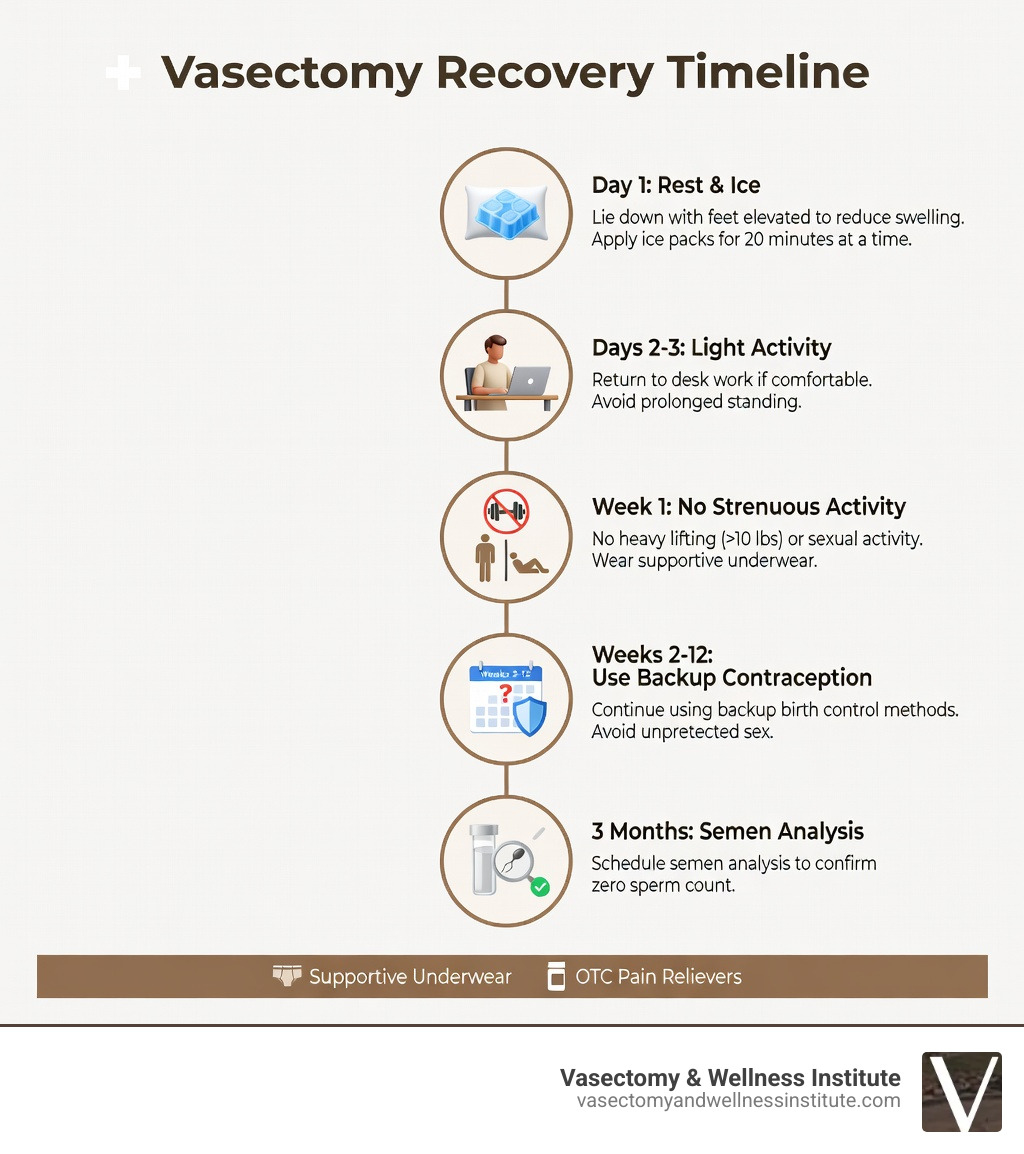
Immediate Post-Procedure: The First 48 Hours
The first two days are the most critical window for your vasectomy recovery. When you leave our clinic in Henderson, the local anesthesia will still be in effect, meaning you won’t feel much initially. However, as that numbness fades, a dull ache or “pulling” sensation in the groin is perfectly normal.
The golden rule for the first 48 hours is simple: horizontal rest. We recommend lying down as much as possible with your feet elevated. This isn’t just an excuse to binge-watch your favorite show; elevating your feet helps minimize bruising and prevents fluid from settling in the scrotum.
The Power of Ice and Support
One of the most effective tools in your recovery kit is a simple ice pack. Applying a cold compress (or even a bag of frozen peas wrapped in a thin cloth) to the scrotum for 15–20 minutes every hour during the first 24–48 hours drastically reduces swelling.
Equally important is scrotal support. Forget your loose boxers for a few days. You need snug, supportive underwear—specifically a jockstrap or tight-fitting briefs. A jockstrap is often superior because it reduces tension on the testicular cord and keeps everything stationary, which significantly alleviates pain. According to scientific research on vasectomy safety and recovery, proper post-operative care is essential for a safe and effective outcome.

At the Vasectomy & Wellness Institute, we specialize in no-needle/no-scalpel techniques that minimize tissue trauma. You can find more info about our vasectomy services to see how our minimally invasive approach leads to a smoother first 48 hours.
Your Vasectomy Recovery Timeline: When to Resume Normal Life
While you might feel ready to conquer the world by Sunday evening after a Friday procedure, your body needs a structured return to activity. Most patients find that they can return to “light” life very quickly, but “heavy” life needs to wait.
| Day | Recommended Activity Level | Work Status |
|---|---|---|
| Day 1 | Strict bed rest / Couch rest | Off |
| Day 2 | Very light walking around the house | Off (unless remote/desk work) |
| Day 3 | Light daily chores, short walks | Return to office/desk jobs |
| Day 4-6 | Gradual increase in walking | Normal daily routine |
| Day 7+ | Resume most activities | Return to manual labor/heavy lifting |
The NHS guidelines on recovering after a vasectomy suggest that while you can return to work within 24 hours if you have a sedentary job, you should still avoid any heavy lifting or strenuous movement. If your job involves manual labor, driving a tractor, or being on your feet all day, we typically recommend taking at least 2–3 days off.
Returning to Work and Exercise During Vasectomy Recovery
Walking is actually encouraged after the first 24 hours because it boosts blood flow and prevents constipation (which can be a side effect of some pain medications). However, the gym is off-limits for at least a week.
We advise a strict 10-pound lifting limit for the first 7 days. This means no heavy grocery bags, no lifting toddlers, and certainly no bench pressing. Activities that involve repetitive friction or impact—such as cycling, running, or contact sports—should be avoided for 7 to 14 days to prevent the internal surgical sites from becoming irritated or reopening. For more specific answers to common concerns, check out our recovery FAQs.
Resuming Sexual Activity and Vasectomy Recovery Precautions
One of the most common questions we hear is: “When can I have sex again?” The general rule is to wait at least seven days. Resuming sexual activity too early can cause discomfort, increased swelling, or even minor bleeding in the semen.
It is important to remember that a vasectomy is not immediate birth control. According to the Mayo Clinic Guide to Vasectomy, sperm can remain viable in the vas deferens for weeks or even months after the procedure. You must continue using backup birth control until a follow-up semen analysis confirms you are “clear.”
Don’t worry about your libido or performance; a vasectomy does not affect testosterone levels, erections, or the sensation of an orgasm. In fact, many couples find their sex life improves once the stress of an unplanned pregnancy is removed!
Managing Pain and Caring for the Surgical Site
Pain management for vasectomy recovery is usually straightforward. Most men find that over-the-counter acetaminophen (Tylenol) is sufficient. We generally advise avoiding aspirin or ibuprofen (Advil/Motrin) for the first 48 hours, as these can thin the blood and increase the risk of bruising or a hematoma (a collection of blood under the skin).
Incision vs. Puncture Care
If you had a traditional vasectomy, you may have small stitches that will dissolve on their own. If you chose our no-scalpel method, you likely only have a tiny puncture that doesn’t even require stitches.
- Showering: You can typically shower 24 hours after the procedure. Do not scrub the area; let soapy water run over it and gently pat it dry.
- Bathing: Avoid soaking in bathtubs, hot tubs, or swimming pools for at least 5 days to prevent infection.
- Hygiene: Keep the area clean and dry. If you notice a small amount of “oozing” on your gauze in the first day, that is normal.
While complications are rare, research on post-vasectomy pain syndrome shows that about 1% to 2% of men may experience ongoing discomfort. This is why following our post-op instructions to the letter is so important. You can learn more about our institute and our commitment to patient comfort and safety.
Long-Term Success and Confirming Sterility
The most important step in your entire vasectomy recovery journey happens about 12 weeks after the procedure: the semen analysis.
A vasectomy is more than 99% effective, but it takes time to “clear the pipes.” You generally need to ejaculate at least 20 times over those 12 weeks to flush out any remaining sperm. About 15 in 10,000 couples may still get pregnant in the first year if they don’t wait for this clearance.
During this period, you might feel a small, pea-sized lump near the surgical site. This is often a “sperm granuloma”—a harmless inflammatory response to sperm leaking from the cut end of the vas deferens. It usually resolves on its own without treatment. Similarly, “scrotal congestion” (a feeling of fullness) can occur but typically passes within a few weeks.
Once you receive the “all-clear” from the lab, you can stop using other forms of contraception. If you’re ready to take the next step, you can request a consultation with our team in Henderson.
Frequently Asked Questions about Vasectomy Recovery
When should I call my doctor about complications?
While we aim for a “boring” recovery, you should contact our medical team if you experience any of the following:
- A fever over 100.4°F (a sign of potential infection).
- Swelling that is getting worse instead of better after the third day.
- A large, painful bulge (hematoma) that feels like a hard grapefruit.
- Pus or foul-smelling drainage from the puncture site.
- Difficulty urinating.
What is the difference between traditional and no-scalpel recovery?
Traditional vasectomy involves one or two small incisions and often requires stitches. Our no-scalpel approach uses a tiny puncture to access the vas deferens. Because there is no cutting of the skin, there is significantly less bleeding, a lower risk of infection, and a faster overall healing time. It is a minimally invasive, “no-needle” option that many Nevada men prefer for its simplicity.
Are there long-term risks after the recovery period?
There are many myths out there, but the science is clear: a vasectomy does not increase your risk of heart disease or prostate cancer. It does not change your voice, your masculinity, or your testosterone levels. Aside from the 1% to 2% risk of chronic pain (Post-Vasectomy Pain Syndrome), which is treatable, there are no significant long-term health risks associated with the procedure.
Conclusion
At the Vasectomy & Wellness Institute in Henderson, Nevada, we believe that permanent contraception shouldn’t be a source of anxiety. By choosing our minimally invasive, no-scalpel procedure, you are already setting yourself up for the fastest possible vasectomy recovery.
Our goal is to provide affordable, expert care that gets you back to your normal life as quickly as possible. Whether you are coming from Las Vegas or right here in Henderson, we are here to support you from the initial consultation through your final “clear” semen analysis. For more information on what we offer, visit our Detailed Services and Pricing page.