

How Much Does a Vasectomy Cost? Here’s What to Expect
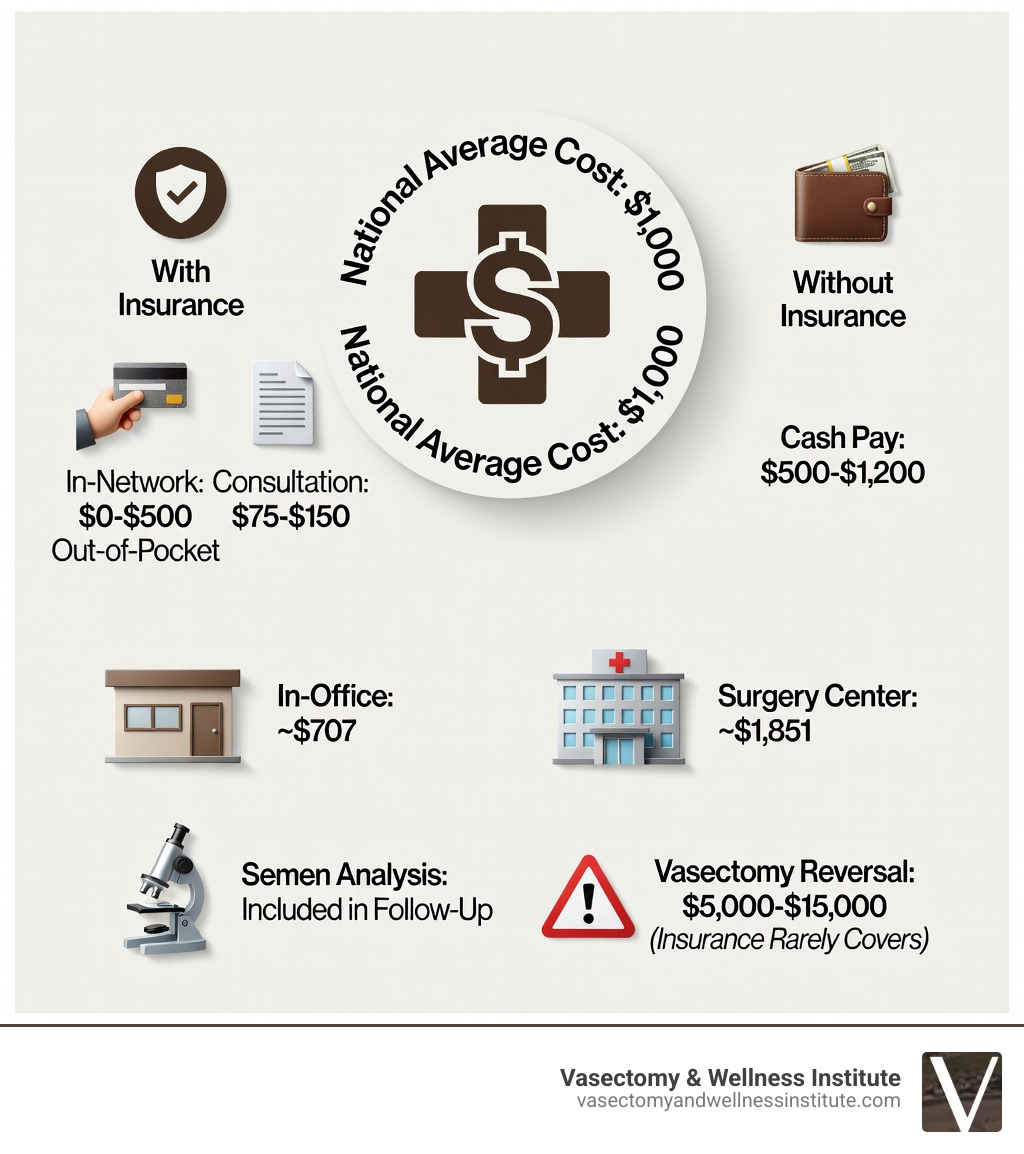
How much does a vasectomy cost depends on a few key factors, but here’s a quick answer:
| Situation | Typical Cost |
|---|---|
| With insurance (in-network) | $0 – $500 out-of-pocket |
| Without insurance (cash pay) | $500 – $1,200 |
| Median self-pay price | ~$1,832 |
| National average (all patients) | ~$1,000 |
| In-office procedure | Lower (~$707 total) |
| Ambulatory surgery center | Higher (~$1,851 total) |
The short version: most men with insurance pay between $384 and $489 out of pocket, including the procedure and follow-up semen analysis. Without insurance, cash-pay prices typically range from $500 to $1,200 depending on where you live and which provider you choose.
If your plan has a high deductible, paying cash can sometimes actually cost less than using insurance.
For many men in their 30s and 40s who are done having children, a vasectomy is one of the most cost-effective permanent birth control decisions they can make. It’s a one-time expense compared to years of ongoing contraception costs that can easily exceed $1,000 per year.
But the total price isn’t always obvious upfront. Consultation fees, facility charges, and follow-up testing can all affect what you actually pay. This guide breaks it all down clearly so you know exactly what to expect before you book.
Average Cost of a Vasectomy in the US
When looking into the financial side of permanent birth control, the most common figure you’ll encounter is a $1,000 estimate. This is a solid baseline for the national average, but the actual “sticker price” can swing wildly based on where you live and the type of facility you choose.

According to scientific research on outpatient vasectomy costs, the variability in pricing is often driven by “facility fees”—charges added by hospitals or specialized surgery centers that don’t exist in a standard doctor’s office. Medicare data suggests that while the surgeon’s fee might remain relatively stable, the total bill changes significantly based on the setting.
For example, a procedure performed in a dedicated urology office is almost always the most budget-friendly option. In contrast, having the same procedure at an ambulatory surgery center (ASC) or a hospital outpatient department (HOPD) can double or triple the total cost.
| Procedure Setting | Average Total Cost | Typical Out-of-Pocket (Insured) |
|---|---|---|
| In-Office | $707 | $173 |
| Ambulatory Surgery Center | $1,851 | $356 |
How much does a vasectomy cost without insurance?
If you are paying out of pocket, you are likely looking for a “cash-pay” or “self-pay” rate. Across the United States, the median self-pay price is approximately $1,832, though the interquartile range (the middle 50% of prices) spans from $815 to over $3,700.
Many men are surprised to find that cash-pay rates are often more transparent and sometimes even lower than the “negotiated” rates insurance companies use. At specialized clinics, you can often find more info about vasectomy services that include flat-fee pricing. In many regions, including right here in the Southwest, a typical cash-pay range for an uncomplicated, in-office procedure is between $500 and $1,200.
For those facing financial hardship, some non-profit clinics or community health centers offer sliding scale fees based on income. It is always worth asking a provider if they offer a discount for paying in full at the time of service, as this eliminates the administrative headache of insurance billing for the office.
How much does a vasectomy cost with insurance?
For those with commercial health insurance, the question isn’t “what does it cost?” but “how much of my deductible have I met?” Because most vasectomies are performed as outpatient procedures, your insurance will typically cover the cost after you’ve paid your yearly deductible.
Recent research on interhospital price variations indicates that for the average insured patient, the out-of-pocket range sits narrowly between $384 and $489. This usually covers the initial consultation, the procedure itself, and the vital post-vasectomy semen analysis (PVSA).
However, if you have a high-deductible health plan (HDHP), you might be responsible for the full “negotiated rate” until that deductible is hit. In some cases, this rate can be as high as $4,000 if the procedure is done in a hospital setting. To avoid these surprises, we always recommend that you request a consultation to get a clear breakdown of the expected charges based on your specific plan.
Factors That Influence How Much a Vasectomy Cost
Several variables can push the price of a vasectomy up or down. Understanding these can help you choose the best value for your care.
- The Procedure Setting: As mentioned, an office-based procedure is the “gold standard” for cost-efficiency. Hospitals charge “facility fees” to cover their massive overhead, which can add $500 to $1,500 to your bill without changing the quality of the medical outcome.
- Technique and Technology: Traditional scalpel vasectomies are the older method. Modern, minimally invasive “no-scalpel” and “no-needle” techniques are often preferred by patients for their comfort and quick recovery. While the base CPT code (the billing code) is often the same, some “premium” clinics may charge a service fee for advanced comfort measures like no-needle jet anesthesia.
- Geographic Location: Healthcare costs are tied to the local economy. A urologist in New York City or San Francisco will naturally have higher overhead than a provider in a more affordable market.
- Physician Experience: While a general surgeon can perform a vasectomy, many men prefer a urologist who specializes in the procedure. High-volume specialists often have lower complication rates, which saves you money on potential follow-up care or prescriptions.
- Anesthesia Type: Most vasectomies are done under local anesthesia (you are awake, but the area is numb). If you request “twilight sleep” or general anesthesia, the cost will skyrocket because you will need an anesthesiologist and a surgical suite.
Research on healthcare cost burden for vasectomy confirms that choosing an in-office setting is the single most effective way to keep your costs low.
Insurance Coverage and the Affordable Care Act
There is a common misconception that the Affordable Care Act (ACA) makes all birth control free. Under the ACA, insurance companies are required to cover “essential health benefits,” which includes 18 methods of contraception for women at $0 out-of-pocket. Unfortunately, vasectomy is not currently classified as an essential health benefit for men under federal law.
However, this doesn’t mean it isn’t covered. Most private insurance plans do cover vasectomies as a standard outpatient benefit. Additionally, nine states currently have mandates requiring private insurers to cover vasectomies with no cost-sharing, though Nevada is not currently on that specific list.
For those on Medicaid, coverage varies by state, but many programs do cover the procedure (often requiring a 30-day waiting period and a signed consent form). If you have an HSA (Health Savings Account) or FSA (Flexible Spending Account), your vasectomy is a 100% eligible medical expense, allowing you to pay for the procedure using pre-tax dollars. For more specific details on how these rules apply to our practice, you can check our FAQs about coverage.
Comparing Vasectomy Costs to Other Birth Control Methods
When men ask, “how much does a vasectomy cost,” they are often looking at the upfront price tag. But to get the full financial picture, you have to compare it to the “subscription model” of other birth control methods.
Temporary methods like birth control pills, patches, or condoms require monthly or yearly spending that never ends. Long-acting reversible contraception (LARCs) like IUDs or implants are effective but must be replaced every 3 to 10 years at a cost of $1,000 or more per insertion.
According to a study on the cost effectiveness of contraceptives in the United States, vasectomy is the most cost-effective permanent option available. It is roughly six times cheaper than female sterilization (tubal ligation), which is a much more invasive surgery requiring general anesthesia and a hospital stay.
Over a decade, a couple relying on condoms might spend over $1,200, while those using brand-name pills could spend over $6,000. A one-time $1,000 investment in a vasectomy pays for itself within just a few years.
Additional Expenses: Consultations, Follow-ups, and Reversals
When budgeting, make sure you are looking at the “total package.” A quote for the “procedure” might not include everything you need.
- Consultation Fees: Most urologists require an initial visit to discuss your medical history and the procedure. These typically range from $75 to $150.
- Post-Vasectomy Semen Analysis (PVSA): This is the most important part! You aren’t “clear” until a lab confirms there is no sperm in your semen (usually 8-16 weeks post-op). Some clinics bundle this into the price, while others may charge $50–$100 per test.
- Recovery Supplies: You’ll need a few bags of frozen peas, some snug-fitting underwear or a jockstrap, and perhaps some over-the-counter pain relievers. Total cost: about $30.
- Vasectomy Reversal: Life happens, and sometimes men want to restore their fertility. You should know that a clinical update on vasectomy reversal shows these procedures are highly complex. They are almost never covered by insurance and typically cost between $5,000 and $15,000. Because of this, we always advise patients to view a vasectomy as a permanent decision.
If you have questions about our all-inclusive pricing or what your specific out-of-pocket might be, please contact us for pricing details.
Frequently Asked Questions about Vasectomy Pricing
Are there low-cost or free vasectomy options available?
Yes. In many areas, Medicaid covers the full cost of a vasectomy for eligible men. Additionally, organizations like Planned Parenthood often offer sliding scale fees based on your income level. If you are uninsured, many private practices (like ours) offer competitive cash-pay rates that are significantly lower than the “billed” rates sent to insurance companies.
Does insurance cover vasectomy reversal?
In the vast majority of cases, no. Insurance companies view reversal as an elective fertility procedure rather than a medical necessity. However, you can typically use your HSA or FSA funds to pay for a reversal if you choose to have one.
What are the hidden costs of a vasectomy?
The most common “hidden” costs are facility fees (if you go to a hospital) and pathology charges. Some doctors send a small piece of the removed tissue to a lab to confirm it is indeed the vas deferens; this can result in a separate lab bill. At the Vasectomy & Wellness Institute, we aim for total transparency so you aren’t surprised by “extra” bills weeks later.
Conclusion
At the Vasectomy & Wellness Institute in Henderson, Nevada, we believe that taking control of your reproductive health shouldn’t be a financial burden. We specialize in the no-needle, no-scalpel vasectomy—a technique designed for maximum comfort and a quick recovery. By focusing on an office-based, patient-centered model, we are able to provide affordable expert care that avoids the high facility fees associated with hospitals.
Whether you are looking to use your insurance benefits or are interested in our competitive cash-pay options, our team is here to help you navigate the process with ease. Ready to take the next step? Start your journey at the Vasectomy & Wellness Institute today.