

What Does a Vasectomy Cost? Here’s What to Expect
Vasectomy cost is one of the first things men want to know before deciding on permanent birth control — and the answer depends on where you live, your insurance, and the type of procedure you choose.
Here’s a quick breakdown:
| Situation | Typical Cost |
|---|---|
| With insurance (US) | $0 to ~$500 out-of-pocket after deductible |
| Without insurance (US) | $500 to $1,250 (national average ~$957) |
| With facility fees (US) | Up to $1,026 or more |
| Vasectomy reversal (if needed later) | $5,000–$15,000 |
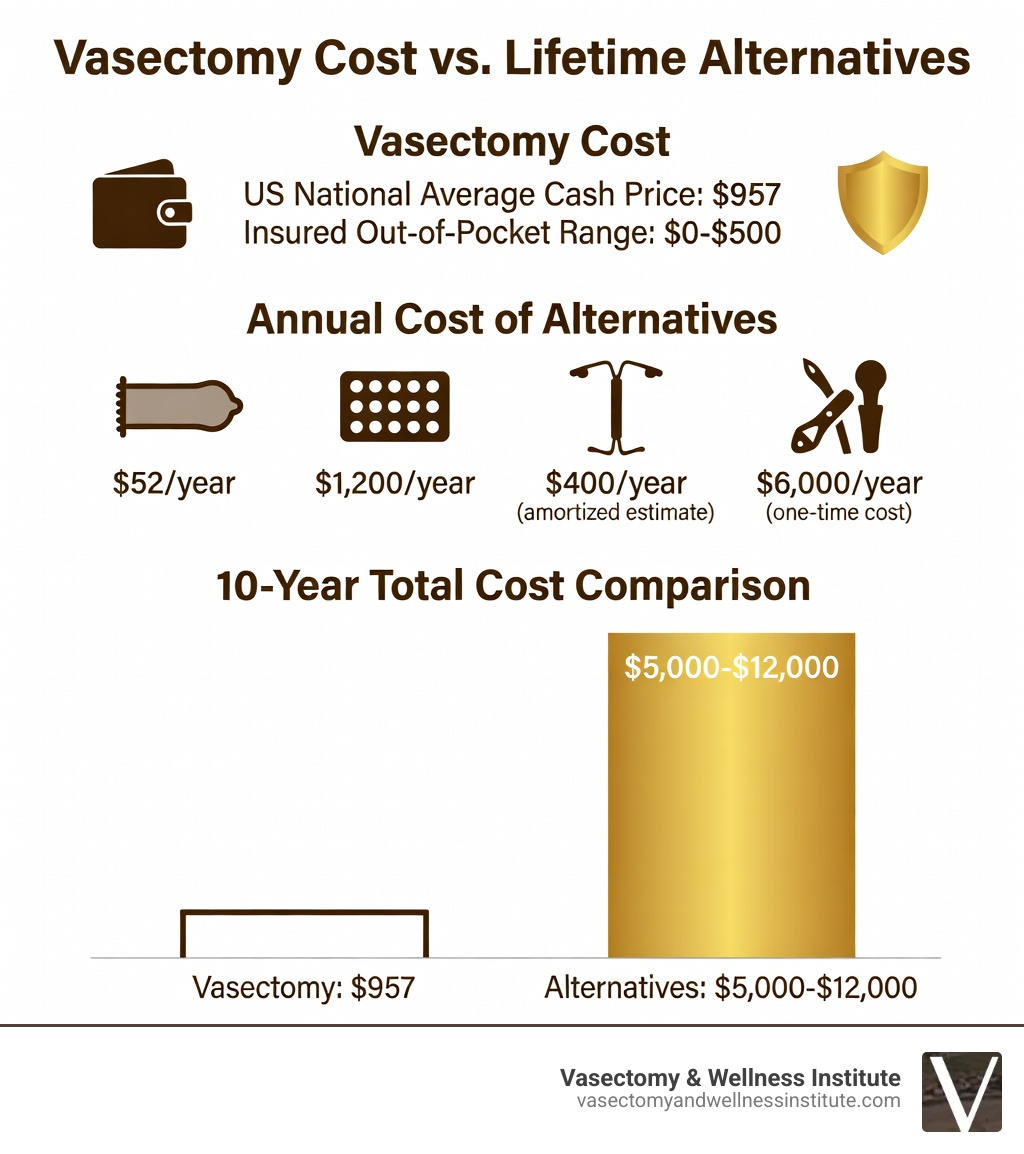
The good news? Even at full cash price, a vasectomy is a one-time cost — unlike ongoing birth control methods that can cost over $1,000 per year.
A vasectomy is a short outpatient procedure (typically 10–30 minutes) performed under local anesthesia. It’s more than 99% effective and, for most men, far less expensive over a lifetime than any other contraceptive option. Annual out-of-pocket costs for other birth control methods can exceed $2,000 per year, making vasectomy one of the smartest long-term financial decisions a couple can make.
In the sections below, we break down exactly what drives vasectomy pricing, what insurance typically covers, what hidden fees to watch for, and how to find transparent, affordable care.
Average Vasectomy Cost Without Insurance
When you are paying out-of-pocket, the price tag for a vasectomy can feel like a moving target. If you don’t have health insurance, or if you have a high-deductible plan where you’ll essentially be paying the full “cash price” anyway, understanding the national landscape is vital for your financial planning.

The national average cash price for a vasectomy in the United States is approximately $957, according to national healthcare pricing data. However, “average” is just a middle point in a very wide spectrum. Real-world data shows that self-pay pricing for vasectomy is highly variable across the country. You might find a clinic in one region charging as little as $598, while a specialist in a high-cost-of-living metropolitan area might charge $1,250 or more for the exact same 15-minute procedure.
According to a study on self-pay pricing variability in the United States, the median self-pay price was found to be $1,832 in some hospital settings, though in-office procedures remain significantly more affordable. This highlights a massive gap between “office-based” and “hospital-based” care.
Regional Price Ranges
Geography plays a massive role in your final bill. While prices vary significantly by state and city, the national range typically falls between $511 and $1,250+ for the procedure itself.
When looking at the financial considerations and outpatient modeling of these costs, it becomes clear that the “all-in” price often includes the initial consultation, the procedure itself, and the all-important follow-up semen analysis.
Factors That Influence the Price of a Vasectomy
Why does one doctor charge $600 while another charges $1,200? It isn’t always about the quality of the coffee in the waiting room. Several specific factors drive the vasectomy cost up or down.
- Geographic Location: Just like rent or a gallon of milk, medical services cost more in high-cost-of-living areas.
- Provider Expertise: A specialist who focuses exclusively on vasectomies may charge a premium, but they often provide a faster, more comfortable experience with lower complication rates. You can find more info about vasectomy services to see how specialized care differs from general urology.
- Anesthesia Types: Most vasectomies use local anesthesia (numbing the area). However, if you are particularly anxious and request “twilight sleep” or general anesthesia, your costs will skyrocket due to the need for an anesthesiologist and a surgical suite.
- Procedure Type: The modern “no-needle, no-scalpel” method is the gold standard for comfort. While many clinics keep the price the same as traditional methods, some may charge a slight premium for the specialized equipment used in the “no-needle” spray applicator.
- Consultation Fees: Some clinics bundle the consultation into the procedure price, while others charge for it separately.
Research on physician ownership and practice patterns suggests that where a doctor performs the surgery also impacts the price significantly.
Understanding Facility Fees and Hidden Vasectomy Cost
The biggest “trap” in medical pricing is the facility fee. If your vasectomy is performed in a hospital outpatient department (HOPD) or an Ambulatory Surgery Center (ASC), you will likely receive two bills: one from the doctor and one from the building.
The impact of facility fees on out-of-pocket costs can be staggering. While an in-office procedure might cost you $400 out-of-pocket with insurance, that same procedure in a hospital could cost over $1,026 because of these extra charges.
Other “hidden” costs to ask about include:
- Surgical Supplies: Some clinics charge a “block fee” or supply fee (ranging from $170 to $300) to cover the specialized kits used during the procedure.
- Post-Op Recovery Kits: These may include scrotal supports, specialized ice packs, and medications.
- Pathology: While AUA guidelines don’t require it, some doctors send the removed segments of the vas deferens to a lab to “prove” they were cut, which adds a separate lab fee.
Comparing Long-Term Birth Control and Vasectomy Cost
If you are hesitant about the upfront vasectomy cost, it helps to look at the “Big Picture.” When we compare a one-time investment to the recurring costs of other methods, the savings are undeniable.
According to research on the cost effectiveness of contraceptives in the United States, vasectomy is one of the most cost-effective medical interventions available today. It pays for itself in less than a year when compared to many other temporary contraceptive options.
Insurance Coverage and Out-of-Pocket Expenses
For many of our patients, the primary question isn’t “how much is it?” but “will my insurance pay for it?”
Unlike female birth control, which is mandated as an “essential health benefit” under the Affordable Care Act (ACA), vasectomy coverage is not strictly required for all private plans. However, most major private insurance companies do cover it because they recognize it is much cheaper to pay for a vasectomy than for prenatal care and delivery!
What you need to know about insurance:
- Deductibles: If you have a $3,000 deductible and haven’t spent any money on healthcare this year, you will likely pay the full contracted rate for the vasectomy.
- Co-payments: Once your deductible is met, you may only owe a small co-pay (often $30–$100).
- Medicaid: Most state Medicaid programs cover vasectomy, though there is often a mandatory 30-day waiting period and a minimum age requirement (usually 21).
- HSA and FSA: Vasectomies are HSA and FSA eligible, meaning you can use tax-advantaged dollars to pay for the procedure.
Before you book, we always recommend you request a consultation so we can help you navigate your specific plan’s requirements.
Additional Considerations: Follow-up Care
The procedure itself is only part of the journey. A vasectomy is not considered successful until a Post-Vasectomy Semen Analysis (PVSA) confirms there is “no live sperm” in the ejaculate.
The cost of this lab test is usually included in your initial vasectomy cost, but it’s important to confirm this. If you have to go to a third-party lab like Quest or LabCorp, there may be an additional fee of $50 to $150.
Compliance is a major factor here. Studies show that between 22% and 50% of men fail to return for their follow-up test. This is a risky (and potentially expensive) mistake! Until that test comes back clear—usually at the 12-week mark—you must continue using backup birth control. You can find more details on this in our FAQs.
Frequently Asked Questions about Vasectomy Pricing
Are there free or low-cost vasectomy options?
Yes. If you are uninsured or underinsured, you aren’t out of luck.
- Public Health Clinics: Some locations offer sliding scale fees based on your income.
- Community Health Programs: Some counties offer public health initiatives that subsidize the cost of permanent birth control.
- Medicare: While original Medicare generally does not cover vasectomy (as it isn’t considered “medically necessary” for the senior population), some Advantage plans might. You can read more about Medicare coverage limitations to see if you qualify under specific health circumstances.
Does the no-scalpel method increase the vasectomy cost?
Generally, no. Most modern clinics have moved to the no-scalpel technique as the standard of care. According to the CUA guidelines on vasectomy techniques, the no-scalpel method is preferred because it results in fewer infections, less bleeding, and a much faster recovery time.
At our institute, we utilize the no-needle, no-scalpel approach because it provides the most comfortable experience. While the specialized “MadaJet” spray applicator (which replaces the needle) is an advanced piece of technology, we aim to keep our pricing transparent and competitive, ensuring that “premium” care doesn’t mean an unreachable price tag.
Conclusion
Deciding to get a vasectomy is a big step, but the financial aspect shouldn’t be the thing holding you back. When you look at the vasectomy cost as a one-time investment in your family’s future, it becomes clear that it is one of the most affordable and effective healthcare decisions a man can make.
At the Vasectomy & Wellness Institute in Henderson, Nevada, we specialize in making this process as easy as possible. Our USP is simple: we provide a “no-needle, no-scalpel” procedure that is minimally invasive and designed for a quick recovery. We believe in expert care that is also affordable.
Whether you are looking to save on the long-term costs of birth control or you simply want the peace of mind that comes with a permanent solution, we are here to help.
Ready to take the next step? Contact us for transparent pricing or browse more info about our services to learn why men in Nevada trust us with their wellness.