

What Does a Vasectomy Cost Without Insurance in 2026?
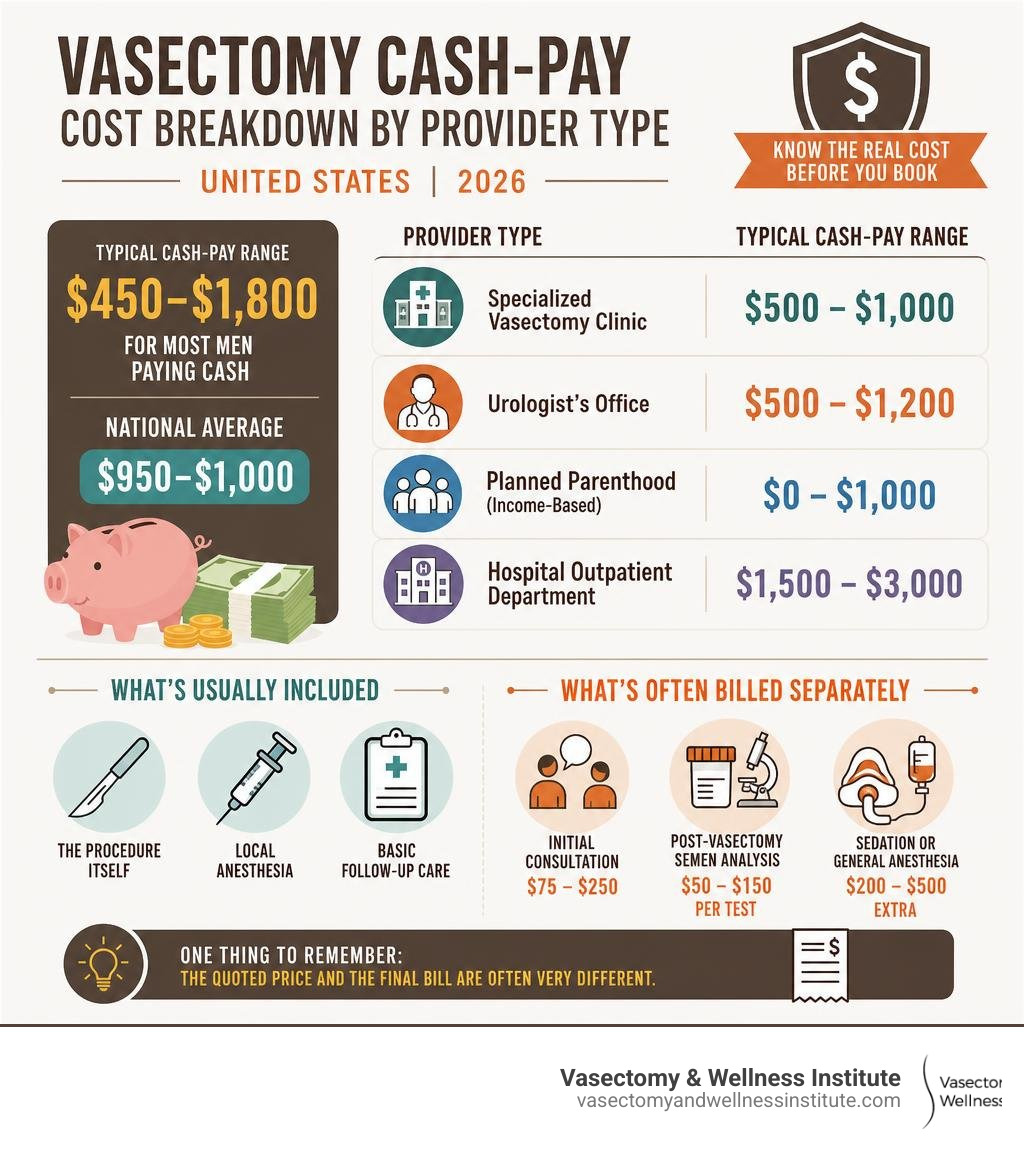
The vasectomy price without insurance typically falls between $450 and $1,800 for most men paying cash in the United States, with a national average around $950 to $1,000.
Here’s a quick snapshot of what to expect:
| Provider Type | Typical Cash-Pay Range |
|---|---|
| Specialized vasectomy clinic | $500 – $1,000 |
| Urologist’s office | $500 – $1,200 |
| Planned Parenthood (income-based) | $0 – $1,000 |
| Hospital outpatient department | $1,500 – $3,000 |
What’s usually included:
- The procedure itself
- Local anesthesia
- Basic follow-up care
What’s often billed separately:
- Initial consultation ($75 – $250)
- Post-vasectomy semen analysis ($50 – $150 per test)
- Sedation or general anesthesia ($200 – $500 extra)
If you’re a married man in your 30s or 40s looking at permanent birth control, the upfront cash cost can feel like a big number. But as you’ll see, the full picture is more encouraging than most men expect.
One thing that surprises many patients: the quoted price and the final bill are often very different things. Facility fees, follow-up lab tests, and anesthesia upgrades can quietly add hundreds of dollars to your total. Knowing what to ask — and what to watch for — makes all the difference.
I’m Dr. Mustafa Ahmed MD, FACS, FAACS, a board-certified surgeon based in Las Vegas, Nevada, with experience in outpatient procedures and surgical financial planning, and I regularly help patients navigate the vasectomy price without insurance so they can make a clear-eyed decision. In the sections ahead, we’ll break down every cost factor so you know exactly what you’re paying for — before you book anything.
Understanding the Vasectomy Price Without Insurance
When you start researching self-pay healthcare options, the first thing you notice is how confusing medical billing can be. If you do not have health insurance, or if you choose to bypass your insurance plan to maintain privacy and avoid bureaucratic hurdles, you are looking at a cash-pay or “self-pay” rate.
Navigating the healthcare system as a cash-paying patient requires a high level of financial transparency. Unlike traditional insurance models where rates are negotiated behind closed doors, paying out-of-pocket means you deserve to know exactly where every dollar goes. However, finding these prices is not always easy. According to a landmark Study on self-pay rate variability, only about 20.5% of hospitals across the United States publicly disclose their self-pay prices for vasectomy procedures. This lack of transparency can make it incredibly difficult for patients to plan their budgets effectively.
When clinics do not publish their rates, patients often face “sticker shock” when the final bill arrives. By choosing providers who prioritize upfront pricing, you can eliminate the anxiety of hidden medical debt and focus entirely on your recovery.
What is the Average Vasectomy Price Without Insurance Across the United States?
Nationally, the average cash price for an in-office vasectomy hovers around $957, with most uncomplicated procedures falling into the $500 to $1,200 range. However, healthcare is highly regional, and where you live plays a massive role in what you will ultimately pay.
For instance, in Nevada, the typical self-pay range for an in-office vasectomy is approximately $650 to $1,050, with the state average sitting right around $1,020. In high-cost metropolitan areas like New York City or San Francisco, patients frequently see base prices starting at $1,250, often with a separate consultation fee of $250 or more billed on top of the procedure. Conversely, in rural clinics or midwestern states, the baseline price might drop closer to $500 or $600.

These regional financial variations are driven by local real estate costs, provider supply, and the general cost of living. Urban centers tend to support higher rates because of increased overhead costs for clinics, whereas community health settings or specialized clinics in suburban areas—such as Henderson, NV—can often offer more competitive, streamlined pricing.
Key Factors Influencing Your Out-of-Pocket Expenses
The final number on your receipt is influenced by several clinical and administrative decisions. Understanding these variables will help you compare quotes accurately:
- The Surgical Setting: Where your procedure takes place is the single largest driver of cost. An in-office procedure is almost always the most affordable option. If your procedure is scheduled in an Ambulatory Surgical Center (ASC) or a hospital outpatient department, you will be hit with a “facility fee” that can easily add $500 to $2,000 to your bill, regardless of the surgeon’s actual fee.
- Anesthesia Choices: A standard vasectomy is performed under local anesthesia (numbing medicine injected directly into the scrotal skin). This is highly effective and keeps costs low. If you experience severe anxiety and request nitrous oxide (laughing gas), oral sedation, or general anesthesia, you can expect the price to rise by $200 to $500—or even up to $3,000 if a separate anesthesiologist must be brought in.
- The Surgical Technique: Traditional scalpel vasectomies require incisions and stitches, which can sometimes increase supplies and follow-up care costs. Modern, minimally invasive no-needle, no-scalpel techniques are highly efficient, often taking under 10 to 15 minutes. While the specialized equipment for no-scalpel procedures carries its own value, many progressive clinics offer it at the same flat rate as traditional methods because the reduced procedure time lowers clinic overhead.
- Provider Expertise: Highly specialized urologists or dedicated men’s health specialists who perform thousands of procedures annually may structure their pricing differently than general practitioners. However, their high volume often allows them to offer highly competitive, all-inclusive cash packages.
To understand how outpatient clinical pathways and facility types impact your final bill, you can read the Scientific research on outpatient expenditures, which highlights how choosing office-based settings over surgical centers drastically reduces out-of-pocket costs for patients.
What is Included in the Self-Pay Rate?
When shopping around, always ask: “Is this an all-inclusive price?”
Some clinics advertise a low baseline price to get you through the door, only to itemize every single bandage, sterile drape, and alcohol swab on your final invoice. A truly transparent self-pay rate should cover the entire clinical pathway. For a detailed breakdown of what a comprehensive, honest pricing structure looks like, take a look at our Comprehensive guide to self-pay sterilization.
Ideally, your cash-pay package should bundle the preoperative consultation, the local anesthetic, the surgical procedure itself, direct access to your clinical team during recovery, and at least one post-vasectomy semen analysis.
The Role of Post-Vasectomy Semen Analysis in Your Financial Planning
A vasectomy is not immediately effective. After the vas deferens are divided, active sperm remain upstream in the seminal vesicles. It typically takes about 8 to 16 weeks, or roughly 20 ejaculations, to completely clear the remaining sperm from your system.
The only way to safely declare your procedure a success is through a Post-Vasectomy Semen Analysis (PVSA). Skipping this test is the leading cause of “unplanned post-vasectomy surprises.”
When planning your budget, you must factor in the cost of this lab work. A single PVSA lab test typically costs between $50 and $150. While most men only require one negative test to receive clinical clearance, approximately 4% to 8% of patients may show persistent, non-motile sperm on their first check, requiring a second test a few weeks later. Ensure your provider clarifies whether this crucial follow-up test is included in your upfront cash price or if you will need to pay a separate laboratory fee down the line.
Hidden Fees: Anesthesia, Pathology, and Consultation Rates
If you do not choose an all-inclusive package, you must watch out for separate bills that may arrive weeks after your procedure:
- The Consultation Fee: Many practices bill the initial evaluation as a separate specialist visit, costing anywhere from $75 to $250.
- Pathology Fees: Some traditional surgeons routinely send the tiny removed segments of the vas deferens to a pathology lab to confirm under a microscope that they are, indeed, the vas deferens. This routine pathology is rarely medically necessary under modern guidelines but can result in an unexpected lab bill of $150 to $300.
- Prescription Medications: You will likely need a mild pain reliever or a brief course of antibiotics. While usually cheap, this is an out-of-pocket pharmacy cost.

Financial Strategies and Alternatives for Uninsured Patients
If you are paying out-of-pocket, you are not without options to make the procedure highly affordable. With a little strategic planning, you can easily fit this permanent health decision into your family’s budget. To explore local resources and cost-saving pathways in southern Nevada, check out our Guide to affordable local options.
Utilizing HSA and FSA Accounts for Your Procedure
Even if you do not have traditional health insurance, you may have access to a Health Savings Account (HSA) or a Flexible Spending Account (FSA) through an employer or a high-deductible health plan.
The IRS classifies vasectomies and their associated follow-up care as fully qualified medical expenses. This means you can use your tax-advantaged HSA or FSA debit card to pay for the entire cost of the consultation, procedure, and semen analysis. By using pre-tax dollars, you can effectively save 20% to 30% on the total cost of your procedure, depending on your tax bracket. Always keep your itemized cash-pay receipt and the clinical summary in your personal files to document the qualified medical expense for tax purposes.
Finding Affordable Options at Community Clinics and Specialized Centers
If funds are tight, look for specialized men’s health centers or community clinics that offer sliding-scale fees based on your household income. Some non-profit family planning clinics receive federal or state funding to subsidize sterilization services for uninsured patients, bringing the cost down significantly.
Additionally, choosing a highly specialized clinic that focuses exclusively on outpatient men’s wellness can save you a fortune. Because these clinics do not deal with the administrative bloat of insurance billing, they can pass those savings directly to you in the form of lower, flat-rate cash prices. For a breakdown of how specialized, office-based care keeps costs low in our region, review our Vasectomy & Wellness Institute affordable care guide.
Long-Term Financial Value: Vasectomy vs. Other Contraceptive Methods
While spending $1,000 today might feel like a significant financial hit, it is helpful to look at contraception as a long-term investment. When evaluated over a lifetime, a vasectomy is actually the most cost-effective birth control method available.
| Contraceptive Method | Upfront Cost | Annual Maintenance | 10-Year Cumulative Cost |
|---|---|---|---|
| Vasectomy (Cash-Pay) | $950 | $0 | $950 |
| Condoms & Spermicide | $0 | $127 | $1,270 |
| Birth Control Pills | $0 | $340 – $1,200 | $3,400 – $12,000 |
| IUD (Replacement every 5 years) | $1,000 (x2) | $0 | $2,000 |
| Female Sterilization (Tubal Ligation) | $6,000 | $0 | $6,000 |
Comparing the Lifetime Vasectomy Price Without Insurance to Temporary Birth Control
Temporary birth control options carry recurring costs that quickly add up over your reproductive years. Buying condoms, paying monthly prescription copays for oral contraceptives, or replacing hormonal implants and intrauterine devices (IUDs) every few years acts as a continuous drain on your wallet.
Furthermore, a vasectomy is about six times cheaper than female sterilization (tubal ligation), which typically requires a hospital operating room, general anesthesia, and a much longer, more painful recovery period. By choosing a one-time, minor office procedure, you eliminate these recurring expenses entirely.
The Long-Term Financial Peace of Mind of Permanent Contraception
Beyond the direct costs of contraceptive supplies, there is the massive, unquantifiable financial peace of mind that comes with permanent contraception. Once your post-procedure semen analysis confirms you are entirely free of sperm, the risk of an unplanned pregnancy drops to virtually zero (99.9% effective).
An unplanned pregnancy carries immense emotional and financial implications. Investing in a permanent solution today protects your family’s long-term financial plan and provides invaluable peace of mind for you and your partner.
Frequently Asked Questions About Self-Pay Sterilization
We know you want clear, direct answers before making a decision. For more localized insights into rates and scheduling in Southern Nevada, you can read More details on regional out-of-pocket rates.
Is a consultation fee billed separately from the procedure?
It depends entirely on the clinic. Some traditional urology practices bill the consultation as a separate specialist visit ($75 to $250), which is collected on your first appointment. At our Henderson clinic, we focus on streamlined, patient-centered care. We offer convenient options where your consultation and your procedure can be completed during the very same visit, helping you save both time and unnecessary travel expenses.
Can I use a health savings account if I do not have traditional health insurance?
Yes! As long as your HSA or FSA account is active, you can use those funds to pay for any IRS-qualified medical expense, regardless of whether you carry traditional health insurance. We provide detailed, itemized receipts that clearly state the medical codes for your procedure, making it simple to submit your documentation for HSA/FSA compliance.
How many semen analyses are required to confirm success?
Under modern American Urological Association (AUA) guidelines, only one negative post-vasectomy semen analysis (showing zero viable sperm) is required to clear you for unprotected intercourse. This test is typically scheduled 12 weeks after your procedure. Until your clinical team explicitly gives you the “all-clear” based on this lab result, you must continue to use an alternative form of birth control.
Conclusion
Paying the vasectomy price without insurance doesn’t have to be a stressful or mysterious process. By choosing an office-based, specialized provider who values upfront, transparent pricing, you can take control of your reproductive health without worrying about hidden hospital fees or surprise bills.
At the Vasectomy & Wellness Institute in Henderson, Nevada, we are proud to serve the Henderson and greater Las Vegas communities. We specialize in the modern, no-needle, no-scalpel vasectomy technique. This minimally invasive approach means:
- No painful needle injections (we use a gentle spray applicator for local numbing)
- No scalpel cuts or stitches (just a tiny puncture that heals naturally in a couple of days)
- A quick, 10-to-15-minute procedure
- A swift, comfortable recovery that gets you back to your normal routine by Monday
We believe in honest, straightforward pricing that makes premium men’s healthcare accessible to everyone. If you are ready to take the next step toward permanent birth control with absolute financial and clinical peace of mind, Schedule your consultation at the Vasectomy & Wellness Institute today. We look forward to helping you make the best decision for your family’s future.