

What to Expect: How Long Does It Take for Vasectomy to Heal?
How long does it take for vasectomy to heal is one of the most common questions men have before getting snipped — and the short answer is: faster than you probably think.
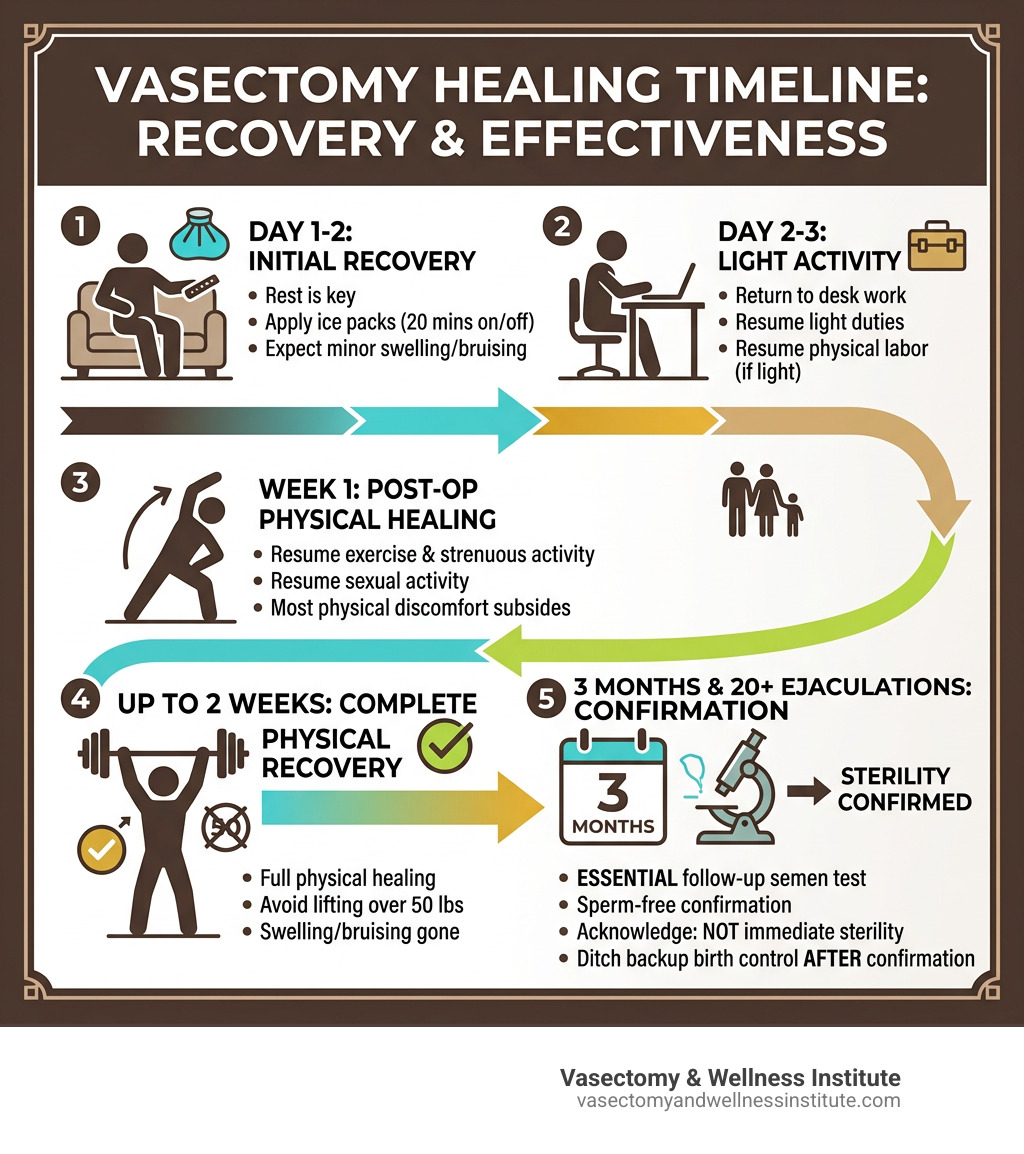
Here’s a quick breakdown of the typical recovery timeline:
| Milestone | Timeframe |
|---|---|
| Return to desk work | 1-2 days |
| Bruising and swelling subside | 1-2 weeks |
| Return to physical labor | 2-3 days |
| Resume exercise and strenuous activity | 1 week |
| Resume sexual activity | 1 week |
| Avoid lifting over 50 lbs | Up to 2 weeks |
| Full physical healing | Up to 2 weeks |
| Vasectomy becomes effective (sperm-free) | ~3 months / 20+ ejaculations |
Most men are back to their normal routine within 48 hours. The first few days involve some soreness, minor swelling, and bruising — all completely normal. By the one-week mark, the vast majority of physical discomfort is gone.
The part that takes longer? Confirming the vasectomy is actually working. Sperm can remain in the reproductive tract for months after the procedure. That’s why a follow-up semen test around 3 months post-surgery is essential before ditching backup birth control.
I’m Dr. Mustafa Ahmed MD, FACS, FAACS, a board-certified surgeon with experience in minimally invasive procedures, and I’ve helped many patients understand exactly how long does it take for vasectomy to heal so they can plan their recovery with confidence. In this guide, I’ll walk you through every stage of the healing process — from the first 24 hours to full sterility confirmation.
Understanding the Procedure: No-Scalpel vs. Traditional Incision
Before we dive into the day-by-day healing process, it is important to understand that how we perform the procedure at the Vasectomy & Wellness Institute directly impacts your recovery speed. A vasectomy works by blocking the vas deferens—the tubes that carry sperm from the testicles to the semen. While the end goal is the same, the method used to get there makes a world of difference for your comfort.
Traditional vasectomies involve one or two small cuts in the scrotum using a scalpel. These incisions often require stitches and can lead to more significant bruising and a slightly longer initial recovery.
In contrast, we specialize in the no-needle/no-scalpel technique. Instead of a knife, we use a specialized tool to make a single, tiny puncture. This puncture is so small that it typically doesn’t even require stitches; it heals over naturally like a small nick from shaving. Because there is less trauma to the tissue, there is less bleeding and a much lower risk of infection. We also use a “no-needle” anesthetic delivery system, which means no scary syringes—just a gentle spray that numbs the area instantly.
For a deeper dive into the specifics of the procedure, you can view our Detailed Guide to Vasectomy Recovery.
| Feature | Traditional Incision | No-Scalpel (Our Method) |
|---|---|---|
| Incision Type | 1-2 cuts with a scalpel | Single tiny puncture |
| Stitches | Usually required | None needed |
| Bleeding/Swelling | Moderate | Minimal |
| Procedure Time | 20-30 minutes | 15-20 minutes |
| Recovery Speed | Standard | Accelerated |
How Long Does It Take for Vasectomy to Heal?

The journey of “healing” happens in stages. While you might feel “fine” after 48 hours, your internal tissues are still doing the hard work of sealing up and settling down.
The First 24 Hours: The “Couch Potato” Phase
Immediately after the procedure, the local anesthetic will keep you numb for a few hours. Once it wears off, you will likely feel a dull ache or some “heaviness” in the scrotum. This is the most critical time for rest. We recommend lying on your back as much as possible with your feet slightly elevated. This helps minimize blood flow to the area, which reduces bruising.
Days 2–3: Turning the Corner
By the second or third day, most men find they can move around the house comfortably. You can usually take a gentle shower at the 24-hour mark, but you should avoid soaking in a bathtub, hot tub, or swimming pool for at least five days to prevent infection.
The One-Week Mark: Back to Normalcy
By day seven, most of the visible bruising and swelling should be significantly improved. You’ll likely feel ready to hit the gym or resume light jogging. However, it’s important to listen to your body. If you feel a “twinge” or aching, back off for another day or two.
Two Weeks and Beyond: Full Recovery
By the 14-day mark, almost all patients are fully healed and back to 100% of their normal activity level. It is worth noting that a very small percentage of men (about 1-2%) may experience post-vasectomy pain syndrome, which is a chronic dull ache. This is rare and treatable, but it’s one reason why following post-op rest instructions is so vital.
Resuming Your Routine: Work, Exercise, and Sex
One of the biggest anxieties men face is when they can get back to their “real life.” Here is the breakdown for the three most common areas of concern.
When can I return to work after a vasectomy?
The answer depends entirely on what you do for a living. If you have an office job where you spend most of your time sitting, you can often return to work within 24 to 48 hours. We generally suggest having the procedure on a Friday so you can be back at your desk by Monday morning.
If your job involves physical labor—such as construction, heavy lifting, or constant walking—you should plan for at least 2 to 3 days of solid rest. Pushing it too early can cause the internal surgical sites to bleed, leading to a painful hematoma (a collection of blood). For more details, see A Comprehensive Guide to Vasectomy Recovery Times.
How long does it take for vasectomy to heal before exercising?
We tell our patients to avoid the gym for at least one full week. While you might feel great on day four, the repetitive motion of running or the abdominal pressure of heavy lifting can cause scrotal swelling to return.
- Light activity: Walking is encouraged after 48 hours to keep blood flowing.
- Heavy lifting: Avoid anything over 50 pounds for at least two weeks.
- Contact sports: Wait at least 7 to 10 days before getting back on the basketball court or soccer field.
How long does it take for vasectomy to heal before having sex?
You should wait at least one week before resuming any sexual activity, including masturbation. Ejaculation involves muscular contractions in the pelvic floor and the vas deferens; doing this too early can cause pain or lead to a small lump called a sperm granuloma.
When you do resume sex, remember the most important rule: You are not sterile yet! You must continue using a backup form of birth control until we give you the “all clear.” You can learn more about our follow-up protocols on our services page.
Essential Tips for a Faster Recovery
A “speedy” recovery isn’t just about luck—it’s about proactive care. Here are the “Golden Rules” we recommend to every patient at our Henderson, NV clinic:
- The “Tighty-Whitie” Rule: Support is your best friend. Forget boxers for at least a week. Wear snug-fitting briefs, compression shorts, or a jockstrap. This prevents the testicles from dangling, which significantly reduces tugging on the surgical site and minimizes pain.
- The 20/20 Icing Rule: For the first 48 hours, apply a cold pack (or a bag of frozen peas) to the scrotum for 20 minutes on, then 20 minutes off. This is the single most effective way to prevent swelling before it starts.
- Pain Management: Most men manage just fine with over-the-counter acetaminophen (Tylenol). We generally advise avoiding aspirin or ibuprofen for the first 48 hours as they can thin the blood and increase bruising, though some doctors may suggest ibuprofen later to help with inflammation.
- Elevate Your Feet: Whenever you are sitting or lying down during the first two days, keep your feet up. This reduces the “heavy” feeling in the groin.
For more clinical insights on these practices, the Cleveland Clinic guide to vasectomy offers excellent supporting information.
Frequently Asked Questions about Vasectomy Healing
When is a vasectomy considered effective?
A vasectomy is not an “instant fix.” There is a “pipeline” of sperm already past the point where we blocked the tubes. It typically takes about 20 to 30 ejaculations or roughly three months to clear out the remaining sperm. We will ask you to provide a semen sample around the 12-week mark. Only after we confirm a zero sperm count under the microscope are you officially cleared to rely on the vasectomy for birth control.
What are the signs of a post-op complication?
While complications are rare—especially with our no-scalpel technique—you should keep an eye out for “red flags.”
Contact us immediately if you experience:
- A fever over 100.4°F (38°C).
- Swelling that is rapidly increasing (e.g., the scrotum reaching the size of a large grapefruit).
- Redness, warmth, or pus draining from the puncture site.
- Severe pain that isn’t helped by rest and medication.
Does a vasectomy affect sexual performance?
This is a common myth, but the answer is a resounding no. A vasectomy only blocks sperm; it does not change your testosterone levels, your sex drive (libido), your ability to get an erection, or the sensation of an orgasm. You will still produce the same amount of semen—it just won’t contain sperm. Many men actually report better sex lives after recovery because the “pregnancy scare” factor has been removed from the bedroom.
Conclusion
At the Vasectomy & Wellness Institute in Henderson, Nevada, we understand that the decision to get a vasectomy is a big one. Our goal is to make the process as seamless as possible through our no-needle/no-scalpel approach, ensuring you spend less time “healing” and more time enjoying your life.
If you follow our simple recovery steps—rest, support, and ice—you’ll likely find that the question of how long does it take for vasectomy to heal has a very satisfying answer: you’ll be back on your feet before you know it.
If you have more questions or are ready to schedule your consultation, please visit our FAQs or contact our office today. We are proud to serve the Henderson and greater Las Vegas community with affordable, expert, and minimally invasive care.