

Understanding Vasectomy Coverage With Insurance
Understanding vasectomy coverage with insurance is simpler than most men expect — here’s a quick breakdown before we dive deeper:
| Scenario | Coverage Status |
|---|---|
| With insurance | Typically covered (subject to plan terms) |
| In mandated states | Fully covered with no patient responsibility |
| Without insurance | Self-pay options available |
A few key things to know upfront:
- Most commercial insurance plans do cover vasectomy, but coverage details depend on your specific plan.
- Services like the consultation, anesthesia, and post-procedure semen analysis are often covered, but may be processed under different benefit categories.
- Nine states (California, Illinois, Maryland, New Jersey, New Mexico, New York, Oregon, Vermont, and Washington) legally require state-regulated insurers to cover male sterilization.
- If you have no insurance, self-pay options are widely available at specialized clinics.
The bottom line: most insured men have coverage for the procedure, depending on their plan’s specific benefits.
Every year, more than 500,000 men in the U.S. choose vasectomy as a permanent birth control solution — and for many, understanding how their insurance handles the procedure is a key step. Between plan benefits, facility designations, and follow-up lab work, navigating insurance coverage can feel like a mystery.
This guide cuts through the confusion. Whether your plan covers the procedure fully or you are exploring self-pay options, you’ll find clear, practical answers here.
I’m Dr. Mustafa Ahmed MD, FACS, FAACS, a board-certified surgeon with experience in minimally invasive procedures and healthcare navigation — including helping patients understand their vasectomy coverage with insurance before they ever walk through the door. In the sections ahead, I’ll walk you through exactly what to expect, so there are no surprises.
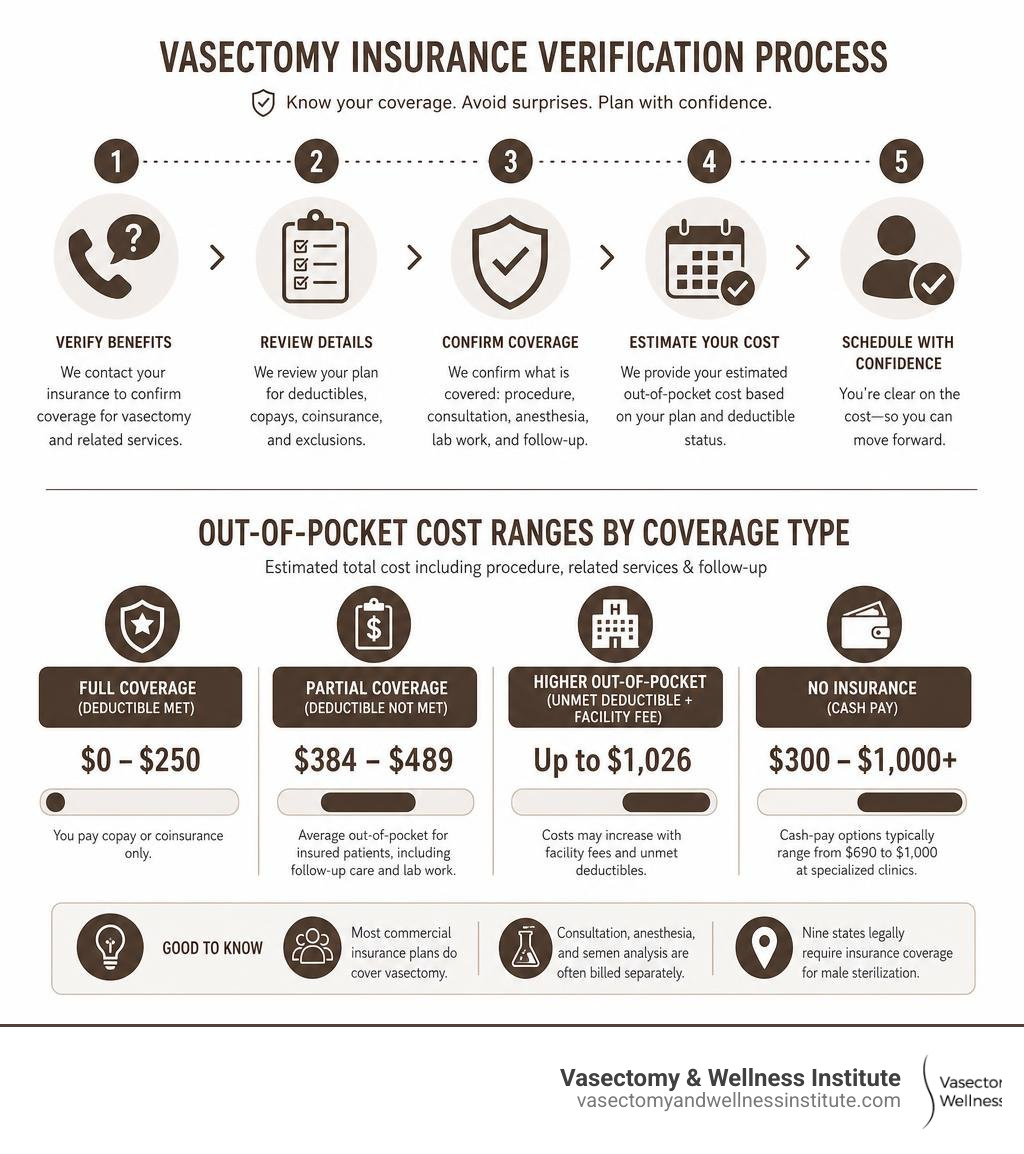
Understanding Your Vasectomy Coverage with Insurance
When you start looking into your vasectomy coverage with insurance, it is easy to get overwhelmed by the sheer volume of healthcare jargon. To understand how your procedure is covered, it helps to look at the clinical and administrative pathways of the procedure.
A landmark scientific research on outpatient financial considerations published in PMC analyzed real patient data to find out how insured patients navigate the clinical pathway. The study modeled realistic patient journeys through the healthcare system.
What the researchers analyzed is the entire clinical pathway—including the initial outpatient consultation, the vasectomy procedure itself, and the critical post-vasectomy semen analysis (PVSA).
Your personal coverage depends entirely on how your specific insurance policy is structured. Unlike female sterilization (such as tubal ligation), which is classified as an essential preventive service under the Affordable Care Act (ACA) and must be covered at 100% with no patient responsibility by most health plans, vasectomies are not federally mandated to be covered without patient responsibility. This means your insurance company can—and usually does—apply your standard plan benefits, such as deductibles or plan benefits, to the claim.
At our practice in Henderson, Nevada, we believe that transparency is just as important as clinical excellence. When you choose our team, we work closely with you to untangle these insurance policies so you know your exact coverage details before your procedure.
How Plan Benefits Affect Your Vasectomy Coverage with Insurance
To understand how your coverage is determined, we need to look at the building blocks of your health insurance plan:
- The Deductible: This is the amount you must pay for healthcare services before your insurance plan starts to pay. If your deductible has not been met, your insurance company will apply the contracted rate for the vasectomy to your deductible.
- The Copayment (Copay): This is a set amount designated by your plan for a specific service. Some insurance plans cover the vasectomy procedure entirely after a flat copay.
- Coinsurance: This is your share of the covered healthcare service, calculated as a percentage after your deductible is met.
- Out-of-Pocket Maximum: This is the limit on what you pay for covered services in a plan year. Once you hit this limit, your plan pays 100% of your covered healthcare costs.
If your deductible is already met for the year, your vasectomy coverage with insurance will likely apply immediately, subject to any copay or plan benefits. To explore how these variables interact, you can read our Detailed Guide to Vasectomy Cost.
Navigating the Clinical Steps and Your Vasectomy Coverage with Insurance
One of the most common reasons patients experience confusion is that they assume the procedure coverage covers everything. In reality, a vasectomy involves several distinct clinical steps, each of which may be processed as a separate line item:
- The Consultation: Before the procedure, you will meet with the surgeon to discuss your medical history, the details of the procedure, and recovery. This is billed as an office consultation.
- The Procedure: This is the actual vasectomy performed by the surgeon.
- Facility Designation: Where your vasectomy is performed matters. If it is performed in a hospital outpatient department or an ambulatory surgery center (ASC), there may be a separate facility claim. Conversely, performing the procedure in a private clinic setting simplifies the billing process.
- Anesthesia: Most vasectomies are performed under local anesthesia, which is highly efficient. If you choose general anesthesia or deep sedation, there will be additional professional services billed.
- Post-Vasectomy Semen Analysis (PVSA): A vasectomy is not immediately effective. You must use alternative birth control until a laboratory analysis confirms that your semen is entirely free of sperm (azoospermia). This follow-up lab work is a separate service.
Because we operate our specialized clinic in Henderson, NV, we perform our painless, no-needle/no-scalpel vasectomies right here in our comfortable office setting. This means our patients avoid the complex facility claims associated with hospitals and surgery centers. For a detailed breakdown of these individual steps, check out our resource on How Much Does a Vasectomy Cost on Average?.
Insurance Coverage Across Major Providers and State Mandates

Navigating the landscape of health insurance can feel like trying to read a map in a different language. However, the majority of commercial (private) health insurance plans in the United States do provide robust coverage for vasectomies, recognizing it as a highly effective and reliable family planning method.
In fact, over the long term, a vasectomy is a highly efficient option compared to using temporary birth control methods.
While coverage is common, the specific contracted allowances—the maximum amount an insurance company approves for a specific service—vary by provider. Let’s look at how coverage breaks down across major commercial plans, government programs, and state-level laws.
| Insurance Type / State | Standard Coverage Status | Key Details |
|---|---|---|
| Aetna | Highly Covered | Subject to plan benefits |
| Blue Cross Blue Shield | Highly Covered | Subject to plan benefits |
| Cigna | Highly Covered | Subject to plan benefits |
| UnitedHealthcare | Highly Covered | Subject to plan benefits |
| Tricare | Covered | Covered for active duty & dependents |
| Medicaid (Nevada) | Covered | Strict consent and age requirements |
| Nevada (State Mandate) | No Mandate | Coverage depends on individual plan |
| Mandated States (e.g., CA, OR, WA) | Fully Covered | Mandated coverage with no patient responsibility |
Commercial Insurance Plans and Medicaid
Most major private insurance companies—including Aetna, Blue Cross Blue Shield (BCBS), Cigna, and UnitedHealthcare—have established guidelines for a vasectomy (specifically billed under CPT code 55250). While these plans cover the procedure, how your benefits are applied depends on your plan’s structure.
- Blue Cross Blue Shield (PPO & Blue Options): Generally cover the procedure well, though HMO plans may require a formal referral from your primary care physician.
- Cigna & UnitedHealthcare: Cover vasectomies under standard outpatient office procedures. It is critical to ensure your doctor is an in-network, contracted provider to maximize your benefits.
- Tricare: As the healthcare program for uniformed service members and their families, Tricare covers vasectomies when performed by an authorized provider. Active-duty service members typically have full coverage, while retirees and dependents may have standard plan guidelines applied.
- Medicaid: Federal law allows state Medicaid programs to cover family planning services, and many do cover vasectomies. However, Medicaid has strict guidelines. Under federal rules, a patient must be at least 21 years old, mentally competent, and must sign a special federal consent form (the sterilization consent form) at least 30 days—but no more than 180 days—prior to the procedure.
To understand how federal guidelines view contraceptive benefits, you can review the official resources on Health Benefits & Coverage: Birth Control – HealthCare.gov.
State-Level Mandates for Male Sterilization
While the Affordable Care Act does not mandate coverage for male sterilization nationwide, several states have stepped in to close this gap. Currently, nine states have passed laws requiring state-regulated health insurance plans to cover vasectomies with no patient responsibility (no copay, no deductible, and no plan-share requirements):
- California
- Illinois
- Maryland
- New Jersey
- New Mexico
- New York
- Oregon
- Vermont
- Washington
Because our practice is located in Henderson, Nevada, it is important to note that Nevada does not currently have a state mandate requiring fully covered vasectomy benefits. This means that if you are a Nevada resident, your vasectomy coverage with insurance will depend entirely on your specific insurance plan’s rules.
If you are looking for local Nevada options, you can read our guide on Low Cost Vasectomy Options in Nevada and Beyond to see how we help keep this essential procedure accessible for our community.
Coverage Alternatives and Planning Strategies

If your insurance plan has a high deductible, or if you do not have health insurance coverage at all, there are several highly effective strategies and options designed to make a vasectomy accessible.
In fact, many patients find that utilizing specialized accounts or self-pay options directly with a specialized clinic is a straightforward and stress-free way to manage their care.
Utilizing HSA and FSA Funds
If you have a High-Deductible Health Plan (HDHP), you likely have access to a Health Savings Account (HSA). Alternatively, your employer may offer a Flexible Spending Account (FSA). Both of these accounts are incredible tools for managing healthcare services.
- Pre-Tax Dollars: HSAs and FSAs allow you to set aside pre-tax dollars directly from your paycheck to pay for eligible medical expenses. This provides a significant tax advantage when managing your care.
- Eligible Expenses: A vasectomy, the initial consultation, and the post-procedure semen analysis are all fully eligible medical expenses under IRS guidelines.
- Easy Payment: Most HSA and FSA plans provide you with a specialized debit card that you can use directly at our office at the time of service, simplifying the administrative process.
Using your HSA or FSA to cover your responsibility is one of the smartest ways to manage the procedure. For more information on how to navigate these options, check out our guide on the Vasectomy Price Without Insurance: Paying Cash for the Snip.
Self-Pay Options and Community Clinics
For patients without insurance, or those who choose not to use their insurance, specialized clinics often offer straightforward self-pay options. These packages often bundle the consultation, the procedure, and the follow-up care into a single, clear arrangement.
If you are facing administrative or coverage challenges, community health organizations and family planning clinics (such as local Planned Parenthood health centers) offer programs based on your household situation. This ensures that every man has access to safe, permanent contraception regardless of his insurance status.
To understand the clinical side of the procedure and what standard care includes, you can read the comprehensive medical overview on Vasectomy: What to Expect – Cleveland Clinic.
Frequently Asked Questions about Vasectomy Insurance
Does the Affordable Care Act mandate vasectomy coverage?
No. While the Affordable Care Act (ACA) requires most commercial insurance plans to cover female FDA-approved contraceptive methods (like tubal ligation, IUDs, and birth control pills) with no patient responsibility, this mandate does not apply to male sterilization. Consequently, unless you live in one of the nine states with specific state-level mandates, your insurance plan is allowed to apply standard plan benefits like deductibles, copays, and plan-share requirements to your vasectomy.
Is post-procedure semen analysis covered by insurance?
In many cases, yes, but it depends on how your doctor’s office bills the procedure. Some clinics bundle the post-vasectomy semen analysis (PVSA) into the global surgical service (using CPT code 55250), meaning it is covered under the initial procedure benefits. However, other clinics or laboratory networks bill the semen analysis separately. If billed separately, it may be subject to your standard laboratory benefits. We recommend verifying with your provider whether the follow-up testing is included in their upfront service package.
How do I obtain a personalized estimate before my procedure?
The best way to get an accurate, personalized coverage estimate is to contact your insurance company’s Member Services department (using the phone number on the back of your insurance card). When you call, provide them with the following specific billing codes:
- Procedure Code (CPT): 55250 (Vasectomy, unilateral or bilateral)
- Diagnosis Code (ICD-10): Z30.2 (Encounter for sterilization)
Ask the representative if these codes are covered under your plan, whether the procedure is classified as an “in-office procedure” or “outpatient surgery,” and how your plan benefits will apply.
Conclusion
When you weigh the long-term convenience of permanent birth control—such as avoiding decades of temporary methods—a vasectomy is undisputedly a highly sensible and effective contraceptive option available to couples.
At the Vasectomy & Wellness Institute in Henderson, Nevada, we are dedicated to making this life-changing decision as seamless and stress-free as possible. We specialize in easy, painless, minimally invasive no-needle/no-scalpel procedures that offer incredibly quick recovery times.
We don’t believe in administrative surprises. Our dedicated billing team will verify your insurance benefits for you ahead of time, helping you understand your exact vasectomy coverage with insurance before you ever step foot in our clinic. If you don’t have insurance, we offer competitive, transparent self-pay options to keep expert care accessible.
Ready to take the next step toward permanent peace of mind? Request a Consultation with us today, and let us help you navigate your clinical and insurance pathway with ease.