

How Long Does a Vasectomy Take to Heal?
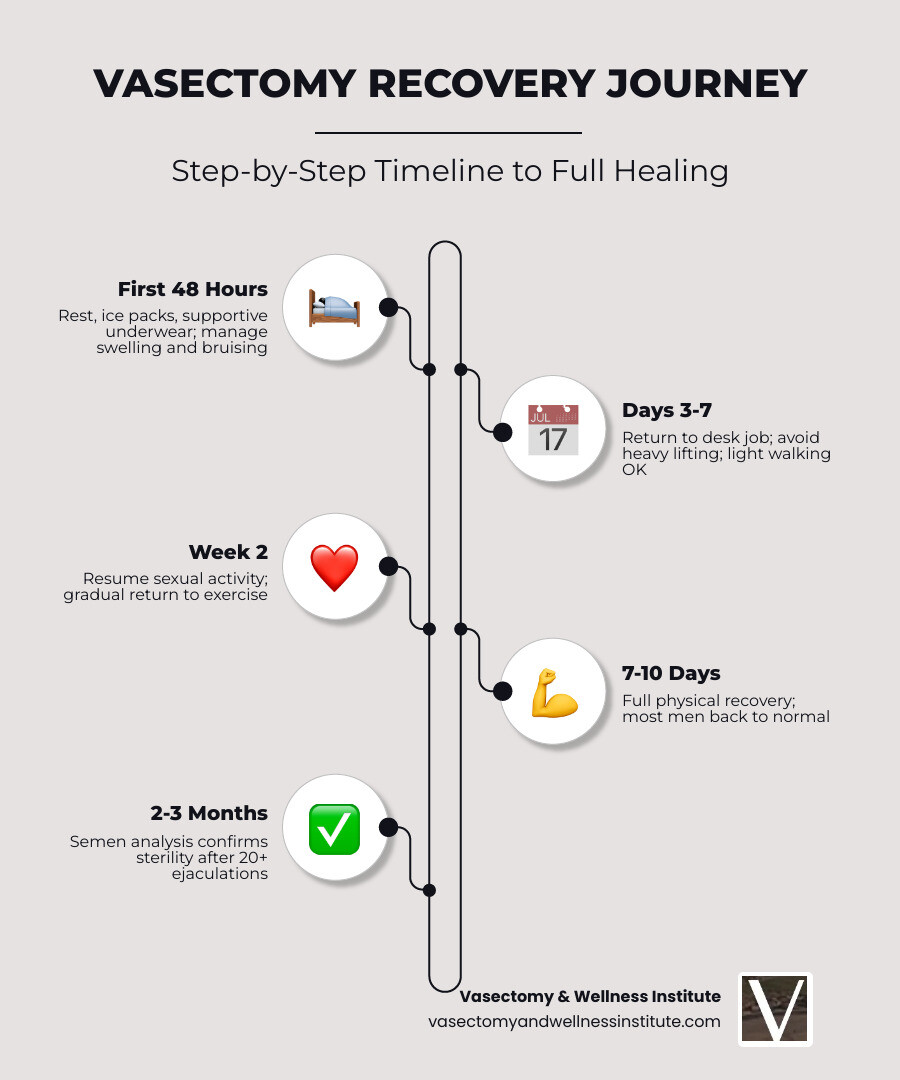
Understanding the vasectomy time to heal is the first thing most men want to know before scheduling the procedure. Here’s the quick answer:
| Recovery Milestone | Typical Timeframe |
|---|---|
| Initial rest period | First 48-72 hours |
| Return to desk job | 1-2 days |
| Return to physical job | Up to 1 week |
| Resume sexual activity | 1-2 weeks |
| Resume strenuous exercise | 1-2 weeks |
| Full physical recovery | 7-10 days |
| Confirmed sterility (semen analysis) | 2-3 months |
Most men feel back to normal within 7 to 10 days. The procedure itself takes only 15 to 30 minutes and is done as an outpatient procedure under local anesthesia. That means you go home the same day.
The physical healing — soreness, swelling, bruising — resolves quickly for most men. But full effectiveness as birth control takes longer, typically around 3 months and at least 20 ejaculations, confirmed by a semen analysis.
The good news: the recovery is far easier than most men expect.
I’m Dr. Mustafa Ahmed MD, FACS, FAACS, a board-certified surgeon with experience in minimally invasive procedures, and I’ve guided many patients through understanding the vasectomy time to heal with confidence. In this guide, I’ll walk you through exactly what to expect at every stage of recovery — so you know precisely what’s coming and how to make it as smooth as possible.
Understanding the Procedure and Initial Healing
To understand the vasectomy time to heal, it helps to know what actually happens during the procedure. A vasectomy is a minor surgical procedure that severs or blocks the vas deferens—the small tubes that carry sperm from the testicles to the urethra. At the Vasectomy & Wellness Institute, we specialize in the no-needle, no-scalpel technique. This method is designed to minimize tissue trauma, which is the primary factor in how quickly you feel “normal” again.
During a no-scalpel vasectomy, we use a specialized instrument to make a tiny puncture in the scrotum rather than a large incision. This means there are no stitches to worry about and significantly less bleeding. Because we use a no-needle anesthesia delivery system, the numbing process is also much more comfortable than traditional methods.
Once the tubes are sealed, your body begins the natural process of tissue repair. In the first few hours, the local anesthesia will wear off, and you may feel a dull ache or heaviness. This is a normal part of the inflammatory response as your body begins to close the small puncture site. Providing proper scrotal support during this phase is crucial for a smooth vasectomy recovery.
Detailed Vasectomy Time to Heal: A Step-by-Step Timeline
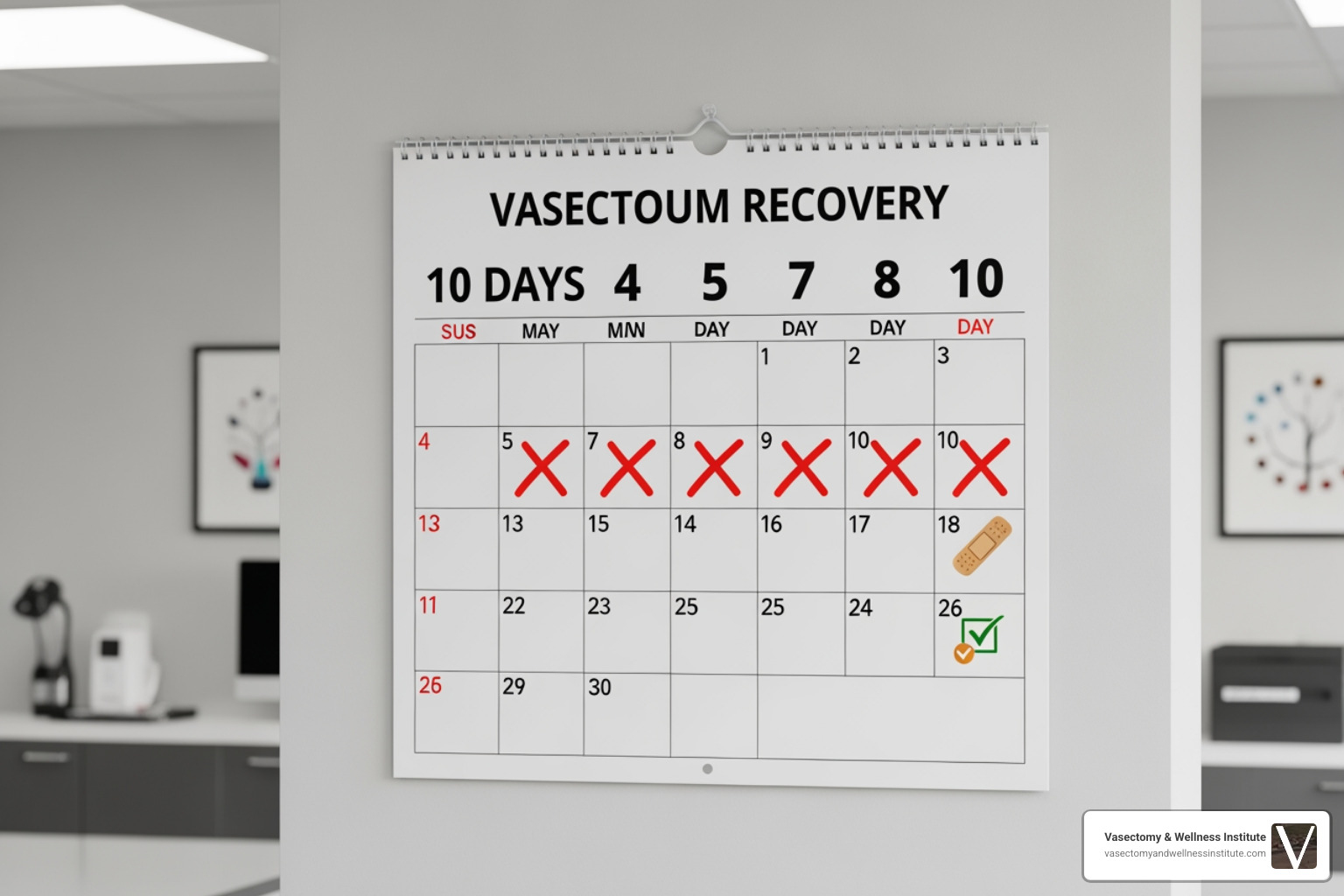
Every man’s body is different, but the vasectomy time to heal generally follows a predictable pattern. While you might be tempted to jump back into your routine if you feel good on day two, following a structured timeline ensures you don’t face setbacks like increased swelling or pain.
The First 48 Hours: Managing Immediate Symptoms
The first two days are the most critical for setting the stage for fast healing. We often tell our patients: “Don’t be a hero.” Even if you feel fine, your internal tissues are still in the early stages of repair.
- Rest: Plan to spend the first 48 hours mostly on the couch or in bed. Keeping your feet elevated can help minimize bruising.
- Ice Packs: Apply ice (or a bag of frozen peas) to the area for 20 minutes on and 20 minutes off. This is the single best way to control swelling during the first 72 hours.
- Supportive Underwear: Ditch the boxers. You need snug-fitting briefs or a jockstrap to keep the scrotum stationary. This prevents the “tugging” sensation that causes discomfort.
- Pain Management: Most men find that over-the-counter acetaminophen (Tylenol) is sufficient. We generally recommend avoiding aspirin or ibuprofen for the first few days as they can thin the blood and increase the risk of bruising.
For more detailed tips on managing these early days, check out our expert advice for faster healing.
Resuming Activities and Exercise During Your Vasectomy Time to Heal
By the third or fourth day, most men are ready to leave the house. However, “returning to activity” is a tiered process.
- Work: If you have a desk job, you can often return within 24 to 48 hours. If your job involves walking or light activity, wait 3 days.
- Walking: Light walking is encouraged after the first 24 hours to promote blood flow, but don’t go for a three-mile hike just yet.
- Heavy Lifting and Strenuous Exercise: This is where most men get into trouble. You must avoid heavy lifting (anything over 10-15 pounds) and vigorous exercise for at least 7 days. This includes the gym, running, and cycling. Straining too early can cause a hematoma (a collection of blood) or increased pain.
According to Medical News Today, resuming these activities too early is the leading cause of post-operative complications. For a day-by-day breakdown, see our detailed guide to vasectomy recovery.
Resuming Sexual Activity and Confirming Effectiveness
One of the most common questions we hear is: “When can I have sex again?” While you might feel ready within a few days, the internal healing of the vas deferens takes a bit longer.
Most experts, including those at Healthline, recommend waiting at least 7 to 14 days before ejaculating. Engaging in sexual activity too early can lead to a condition called epididymitis (inflammation of the tube at the back of the testicle), which is painful and can extend your vasectomy time to heal.
It is also vital to remember that a vasectomy is not effective immediately. There is still “sperm in the pipes” above the site where the tubes were cut. You must continue using backup contraception until you receive a “clear” result from your doctor.
Semen Analysis and the Final Vasectomy Time to Heal Milestone
The final milestone in your journey is the semen analysis. This is the only way to confirm that the procedure was successful and that you are sterile.
- The Waiting Period: You typically need to wait about 3 months (8 to 12 weeks) before having your semen tested.
- The Ejaculation Count: Most doctors recommend at least 20 ejaculations during those three months to “flush out” the remaining sperm.
- The Test: You will provide a sample to a lab. If the lab finds zero sperm, you are officially cleared to stop using other forms of birth control.
Until that lab report comes back negative, you should assume you are still fertile. For more on the timeline of “getting snipped” to being “all clear,” read our article on how long it really takes to heal.
Potential Complications and Long-Term Recovery
While complications are rare—especially with the no-scalpel technique—it’s important to know what to watch for. Most issues occur within the first week.
- Infection: Watch for a fever over 100.4°F, redness that spreads, or pus draining from the puncture site.
- Hematoma: This is a large bruise or blood clot inside the scrotum. Some bruising is normal, but if the scrotum swells to the size of a grapefruit or feels extremely tense, call us immediately.
- Sperm Granuloma: This is a small, harmless lump that can form where sperm leaks from the cut end of the vas deferens. They usually resolve on their own with rest and anti-inflammatories.
- Post-Vasectomy Pain Syndrome (PVPS): This is a rare condition (affecting about 1-2% of men) involving chronic pain that lasts more than three months. Most cases are manageable with conservative treatment.
If you experience severe pain that isn’t helped by ice and Tylenol, or if you have concerns about how your incision is looking, don’t hesitate to contact your healthcare provider. Hackensack Meridian Health notes that most men who follow post-op instructions avoid these complications entirely.
Frequently Asked Questions about Healing After a Vasectomy
Does a vasectomy affect sexual function or libido?
This is a major myth. A vasectomy only blocks sperm; it does not affect your testosterone production, your libido (sex drive), your ability to get an erection, or the sensation of an orgasm. In fact, many couples report an improved sex life because the anxiety of an unplanned pregnancy is removed. Your ejaculate volume will also remain virtually the same, as sperm only makes up about 2-5% of the total fluid.
When can I safely return to the gym or heavy lifting?
The general rule is the “1-week rule.” Avoid the gym, running, and heavy lifting for at least 7 days. When you do return, start at about 50% of your normal intensity. If you feel any pulling, aching, or sharp pain in the groin, stop and wait another few days. For high-impact sports like soccer or basketball, many men prefer to wait 2 weeks and wear a jockstrap for the first few games.
How does the no-scalpel method impact recovery time?
The no-scalpel method significantly reduces the vasectomy time to heal. Because there is no large incision, there is less damage to the blood vessels and nerves in the scrotum. This results in less swelling, a lower risk of infection, and a faster return to daily activities compared to the traditional “two-incision” method. At our Henderson, NV clinic, we find our patients are much more comfortable during and after the procedure thanks to this minimally invasive approach.
Conclusion
The vasectomy time to heal is shorter and more manageable than most men realize. By dedicating just a few days to rest and following a gradual return to activity, you can ensure a smooth recovery and permanent peace of mind.
At the Vasectomy & Wellness Institute in Henderson, Nevada, we are committed to providing the highest level of care. Our no-needle, no-scalpel technique is designed specifically to get you back to your life as quickly and painlessly as possible. We serve the Henderson and greater Las Vegas area with expert, compassionate care tailored to men’s health.
Ready to take the next step toward permanent, worry-free birth control? Schedule a consultation with us today and let us help you navigate your recovery with ease.