

Is a Truly Painless Vasectomy Procedure Actually Possible?
A painless vasectomy procedure is not just a marketing claim — it’s a clinical reality for most men who choose modern no-needle, no-scalpel techniques today.
Here’s the quick answer:
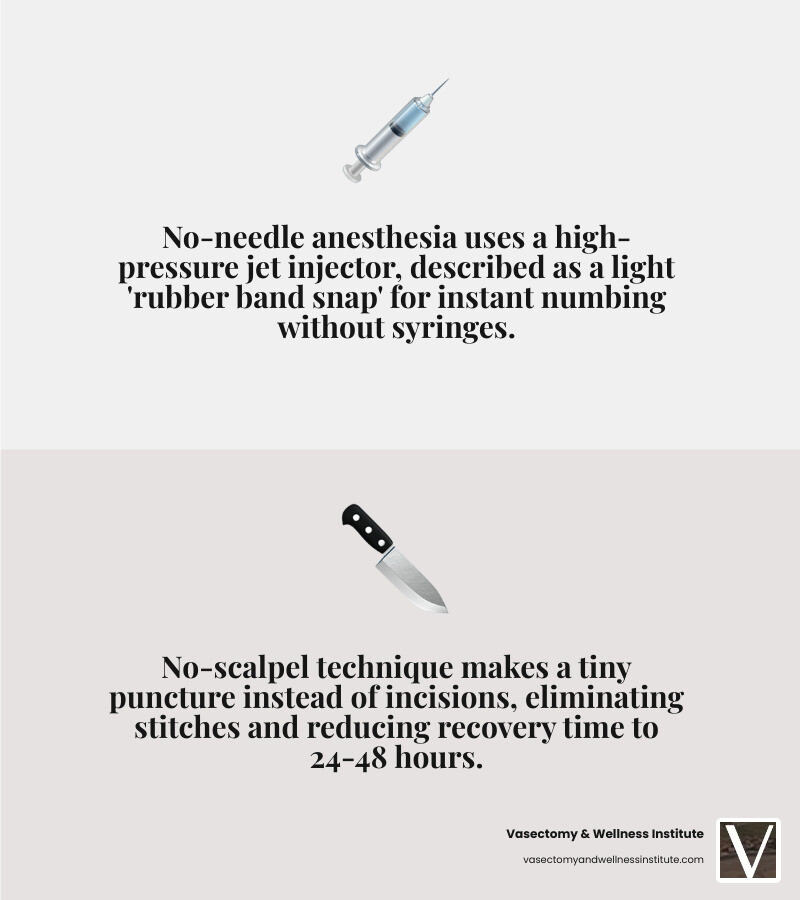
- No needle: Local anesthesia is delivered with a high-pressure jet injector (no syringe), which most men describe as a light rubber band snap
- No scalpel: A tiny puncture replaces any incision — no stitches required
- Minimal pain: Most men report the anticipation is worse than the procedure itself
- Fast: The vasectomy itself takes just 10 to 15 minutes
- Quick recovery: Most men return to light activity within 24 to 48 hours
About 500,000 men in the United States choose vasectomy every year, making it one of the most common surgical procedures performed. Yet many men still hesitate — not because the procedure is dangerous, but because of fear: fear of needles, fear of scalpels, and fear of being awake during a procedure in a sensitive area. That anxiety is completely understandable. The good news is that modern urology has addressed nearly every one of those concerns head-on.
I’m Dr. Mustafa Ahmed, MD, FACS, FAACS, a board-certified surgeon with experience in minimally invasive procedures, and I’ve guided countless men through the decision to pursue a painless vasectomy procedure with confidence. In the sections below, we’ll walk through exactly how this works — from the science of needle-free anesthesia to what recovery actually looks like.
Understanding the Painless Vasectomy Procedure
When we talk about a painless vasectomy procedure, we are referring to a specific combination of medical technologies designed to eliminate the two biggest sources of surgical discomfort: the needle and the scalpel. In a traditional setting, the most painful part of the experience isn’t the surgery itself, but the administration of the local anesthetic. Those multiple needle sticks into highly sensitive tissue are what many men fear most.
Modern techniques utilize no-needle anesthesia, which replaces the syringe with a high-tech jet injector, such as the MadaJet. Instead of piercing the skin with a metal needle, this device uses a high-pressure spray to deliver a fine stream of liquid anesthetic directly through the skin. This “hypospray” technology allows the anesthetic to penetrate the tissue instantly, creating a numbing effect without the trauma of an injection.
According to scientific research on vasectomy prevalence and trends, approximately 500,000 men in the U.S. opt for this permanent birth control method annually. Increasingly, these men are seeking out specialized centers like ours that prioritize comfort. To learn more about how we integrate these technologies into our practice, you can view more info about our specialized services.
How No-Needle Anesthesia Works
The magic of the painless vasectomy procedure begins with the “hypospray” or jet injector. Imagine a tiny, focused stream of air and liquid anesthetic moving so fast that it passes through the microscopic pores of the skin. Most of our patients in Henderson describe the sensation as a light “rubber band snap.”
Because the liquid is dispersed in a mist-like fashion under the skin rather than being pooled in one spot by a needle, the numbing effect is almost instantaneous. This is a game-changer for those with needle phobias. Once the area is numb, the patient typically feels nothing more than mild pressure or a “pulling” sensation during the remainder of the visit. This approach ensures that the “unknown” element—the fear of a sharp poke—is removed from the equation entirely.
Why a Painless Vasectomy Procedure is the Modern Standard
The “No-Scalpel” portion of the procedure is just as vital for comfort as the “No-Needle” part. In a traditional vasectomy, a doctor uses a scalpel to make one or two incisions in the scrotum, which often requires stitches and leads to more significant bleeding and swelling.
In contrast, the modern standard involves a “hemostat puncture.” We use a specialized, sharp-tipped instrument to make a tiny opening—usually only 2 to 3 millimeters in size. Because the skin of the scrotum is naturally stretchy, we can gently expand this opening to access the vas deferens without actually “cutting” the skin in the traditional sense.
The benefits are clear:
- No stitches: The puncture is so small it seals itself, often by the next day.
- Minimal bleeding: We move blood vessels and nerves aside rather than cutting through them.
- Lower infection risk: Smaller openings mean fewer opportunities for bacteria to enter.
- Surgical adhesive: If needed, a tiny drop of medical-grade glue is used instead of sutures that can itch or tug.
Research on the safety and efficacy of no-scalpel techniques confirms that this method is just as effective as traditional surgery but with significantly fewer complications. For a deeper look at what to expect after the numbing wears off, check out our Detailed Guide to Vasectomy Recovery.
No-Needle vs. Traditional Methods: What’s the Difference?
To truly appreciate the painless vasectomy procedure, it helps to see how it stacks up against the “old school” way of doing things.
| Feature | Traditional Vasectomy | No-Needle, No-Scalpel Vasectomy |
|---|---|---|
| Anesthesia | Multiple needle injections | High-pressure jet spray (No needles) |
| Incision | 1-2 scalpel cuts (approx. 1-2 cm) | Single tiny puncture (2-3 mm) |
| Stitches | Required (often 2-4 sutures) | None (self-sealing or surgical glue) |
| Procedure Time | 20–30 minutes | 10–15 minutes |
| Recovery Time | 5–7 days for light activity | 24–48 hours for light activity |
| Bleeding Risk | Higher due to incisions | Minimal due to “poke and spread” |
The traditional method often involves more tissue trauma, which leads to a higher inflammatory response. This is why “your father’s vasectomy” usually involved a week on the couch, whereas today’s patients are often back to their desk jobs within two days. For those concerned about the financial aspect, we provide a transparent look at How Much Does a Vasectomy Cost on Average? to help you plan.
Comparing Recovery Timelines
One of the most significant differences between these methods is the long-term comfort of the patient. Post-Vasectomy Pain Syndrome (PVPS) is a condition where a man experiences chronic discomfort long after the procedure has healed.
The statistics are telling:
- Traditional Vasectomy: PVPS risk can be as high as 24%.
- No-Needle, No-Scalpel: The risk drops significantly to approximately 7%.
This reduction is largely because the minimally invasive approach avoids damaging the delicate nerves and blood vessels in the scrotal sac. Most of our patients find that a 24-hour period of dedicated rest, followed by a day of light activity, is all they need to feel “back to normal.” For a day-by-day breakdown of the healing process, see A Comprehensive Guide to Vasectomy Recovery Times.
The Step-by-Step Process of a No-Scalpel Vasectomy

When you arrive for your painless vasectomy procedure, the atmosphere is much more like a standard office visit than a “surgery.” Here is how the 15-minute process typically unfolds:
- Preparation: You’ll be positioned comfortably on a clinic bed. We often play music or chat to help keep the environment relaxed.
- Anesthesia: Using the jet injector, we apply the local anesthetic. You’ll feel that “rubber band snap” sensation, and within seconds, the area will be completely numb.
- The Puncture: We use a specialized instrument to make a tiny puncture in the midline of the scrotum.
- Accessing the Vas Deferens: The tubes (vas deferens) are gently lifted through the small opening. Because the opening is stretchy, we don’t need a large incision to work.
- Sealing the Tubes: We use a combination of methods to ensure permanent closure. This may include cauterization (using heat to seal the ends) and fascial interposition. Fascial interposition involves sewing a small layer of surrounding tissue over one end of the tube to create a physical barrier, further reducing the 1-in-2,000 risk of the tubes growing back together.
- The “Open-Ended” Technique: In many cases, we leave the testicular end of the tube unsealed (the open-ended technique). This allows sperm to leak into the scrotum where the body naturally resorbs them, which can reduce the “pressure” sensation some men feel after surgery.
- Completion: The tubes are tucked back in, and the puncture site is cleaned. No stitches are applied.
The entire process is efficient and focused on your comfort. If you are curious about the investment for this level of care, read our Detailed Guide to Vasectomy Cost.
Is a Painless Vasectomy Procedure as Effective?
A common question we hear in Henderson is: “If it’s less invasive, is it less effective?” The answer is a resounding no.
The painless vasectomy procedure is actually slightly more effective than traditional methods in some clinical reviews. It boasts a 99.5% success rate. The long-term failure rate is roughly 1 in 4,500—the lowest failure rate of any birth control method available, including IUDs and tubal ligation.
The mechanics of the blockage are identical to traditional surgery; we are simply using more refined tools to reach the tubes. For a more technical look at the biology involved, you can read this scientific overview of vasectomy mechanics.
Recovery and Long-Term Expectations
While the procedure itself is nearly painless, the “wellness” part of our name comes into play during your recovery. You are still undergoing a medical procedure, and your body needs a few days to mend the internal tissues.
The First 48 Hours:
- The “Frozen Pea” Method: We recommend using ice packs (or bags of frozen peas) for 20 minutes on, 20 minutes off. This keeps swelling to a minimum.
- Supportive Underwear: This is non-negotiable. Wear tight-fitting briefs or a jockstrap to keep the scrotum from moving. Movement equals friction, and friction equals discomfort.
- Rest: This is your “get out of chores free” card. Stay on the couch and relax.
The 90-Day Window: It is vital to remember that you are not sterile immediately after the procedure. There is still “live ammo” in the upper part of the tubes. It typically takes about 20 ejaculations or 90 days to clear the remaining sperm. We provide a semen analysis at the 3-month mark to confirm you are “all clear.” Until that lab test comes back with a zero sperm count, you must continue using another form of contraception.
For more tips on navigating the weeks following your visit, visit our Frequently Asked Questions.
Frequently Asked Questions about Painless Vasectomy
Does the procedure affect sexual function or libido?
This is perhaps the #1 concern for men. The answer is a definitive no. A vasectomy only blocks the sperm; it does not touch the nerves responsible for erections, nor does it affect the testicles’ ability to produce testosterone. Your libido, your ability to perform, and the sensation of orgasm remain exactly the same. In fact, many couples report an improved sex life because the fear of unwanted pregnancy is removed. You will still ejaculate; sperm only makes up about 5% of the total volume of semen, so you won’t notice a difference in “output.”
Is the no-needle, no-scalpel procedure reversible?
Yes, but it should be viewed as a permanent decision. A vasectomy reversal is a much more complex microsurgery that is often not covered by insurance. Interestingly, the open-ended technique we use often has higher success rates for reversal because it prevents “back pressure” from damaging the epididymis. However, we always advise our patients to be 100% certain they are done having children before scheduling. You can find more info about reversal considerations here.
Who is the ideal candidate for this technique?
If you are a man who is certain his family is complete, or you have decided that fatherhood isn’t in your future, you are a candidate. This technique is especially ideal for men who have avoided vasectomy due to “white coat syndrome” or a fear of needles. Whether you are a busy professional in Henderson or a father of three looking for a permanent solution, our painless vasectomy procedure is designed to fit into your life with minimal disruption.
Conclusion
At the Vasectomy & Wellness Institute in Henderson, Nevada, we believe that taking control of your reproductive health shouldn’t be a source of trauma. By utilizing the latest no-needle and no-scalpel technologies, we’ve turned a once-dreaded surgery into a quick, affordable, and nearly painless office visit.
Our mission is to provide expert care that respects your time and your comfort. If you’re ready to move forward with the most effective form of birth control available, we invite you to take the next step. Our team is here to answer your questions and ensure your experience is as stress-free as possible.
Ready to take control? Request a Consultation with us today and discover how easy a modern vasectomy can be.