

Why Men’s Sexual Health Treatment Matters More Than You Think
Men’s sexual health treatment covers a wider range of conditions than most men realize — and more men need it than you might expect.
Here’s a quick overview of the most common conditions and their first-line treatments:
| Condition | How Common | First-Line Treatment |
|---|---|---|
| Erectile Dysfunction (ED) | ~40% of men at 40; ~70% by age 70 | PDE5 inhibitors (e.g., sildenafil, tadalafil) |
| Low Testosterone | ~53% of men over 65 | Hormone replacement therapy |
| Peyronie’s Disease | Less common; any age | Monitoring, medication, or surgery |
| Male Infertility | Up to 1 in 3 infertility cases | Depends on cause; semen analysis first |
| Psychogenic ED | Very common | Counseling, sex therapy, lifestyle changes |
Sexual health problems are extremely common in men — yet most men stay silent about them for years.
Consider this: roughly 52% of men between 40 and 70 have some form of erectile dysfunction. That’s not a rare condition. That’s the majority.
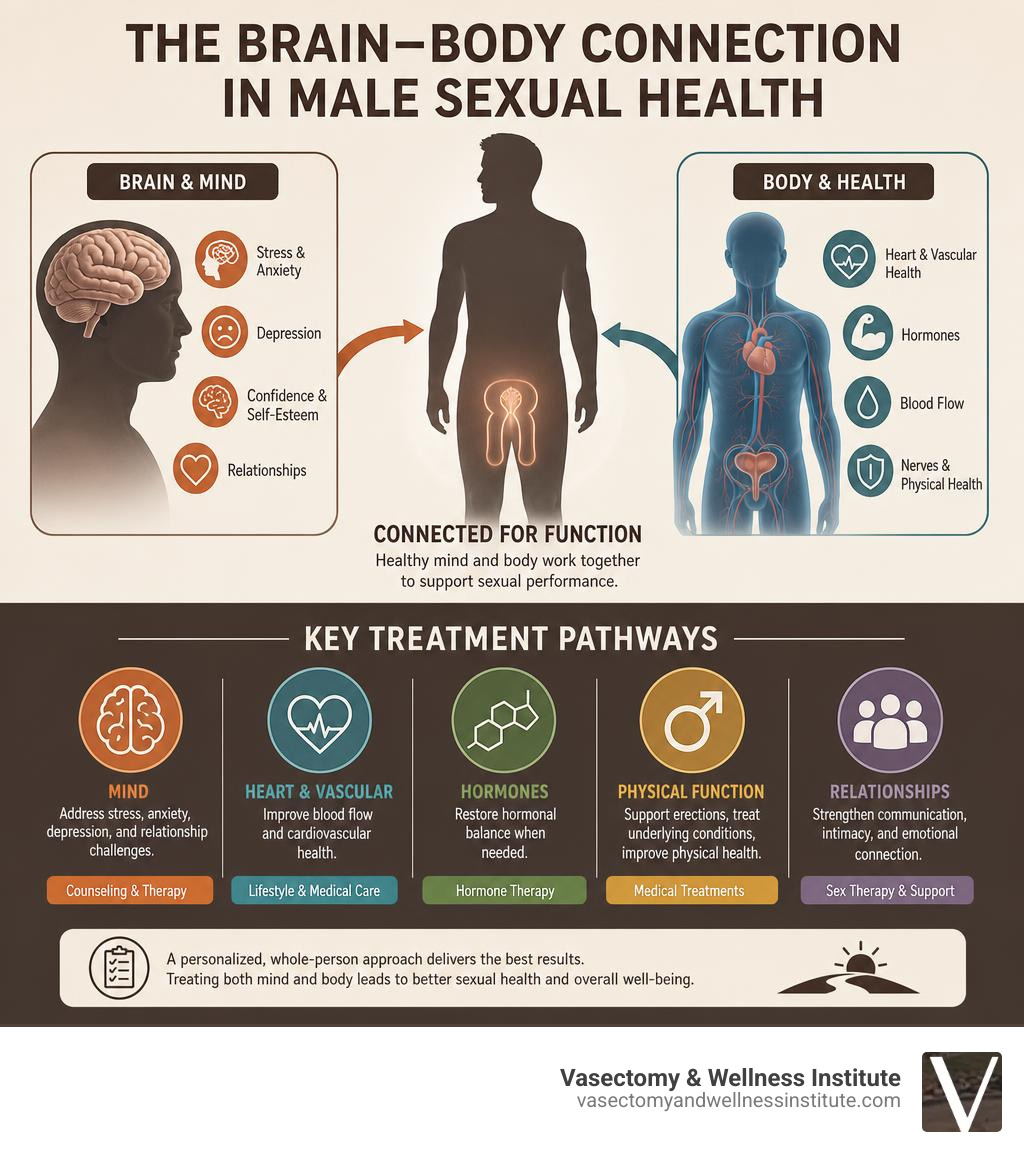
And ED is just one piece of the puzzle. Low testosterone, Peyronie’s disease, male infertility, and the mental health side of sexual performance all play a role in a man’s overall sexual wellness. These conditions are deeply connected — to your heart health, your hormones, your stress levels, and yes, even your relationship.
Here’s something worth knowing upfront: the most important sex organ isn’t below the waist — it’s the brain. Stress, anxiety, and depression can be just as responsible for sexual dysfunction as any physical condition. That means treatment often needs to address both body and mind.
The good news? Most of these conditions are treatable. Many are even preventable.
I’m Dr. Mustafa Ahmed MD, FACS, FAACS — a board-certified physician in internal medicine, surgery, and surgical critical care, with experience in the full spectrum of men’s wellness, including the physical and systemic factors that drive men’s sexual health treatment decisions. In this guide, I’ll walk you through everything you need to know to start feeling like yourself again.
Understanding Common Men’s Sexual Health Conditions

When we talk about men’s sexual health, it is easy to focus entirely on erectile dysfunction. While ED is certainly the most widely discussed issue, a comprehensive approach to men’s sexual health treatment must look at the entire reproductive and vascular system. Men frequently experience a range of interconnected physical and structural challenges, including hormonal declines, structural changes in the penis, and fertility struggles.
To provide standardized, evidence-based care, modern medicine relies on clinical guidelines established by leading global organizations. For instance, the EAU Guidelines – Editor’s choice European Association of Urology Guidelines on Male Sexual and Reproductive Health: 2025 Update on Male Hypogonadism, Erectile Dysfunction, Premature Ejaculation, and Peyronie’s Disease provides urologists and wellness specialists with a rigorous framework for diagnosing and managing these conditions. These guidelines emphasize that sexual dysfunction is rarely an isolated issue; rather, it is often a visible indicator of a man’s broader cardiovascular, metabolic, or psychological health.
The Prevalence of Erectile Dysfunction and Infertility
The numbers surrounding male sexual dysfunction are eye-opening. Erectile dysfunction is a progressive condition that closely correlates with aging. At age 40, approximately 4 in 10 men experience some degree of ED. By the time men reach age 70, that number climbs to 7 in 10. Globally, the prevalence is rising rapidly; researchers estimate that by the end of 2025, over 322 million men worldwide will live with ED. This increase is driven not only by an aging global population but also by rising rates of metabolic conditions like diabetes, obesity, and cardiovascular disease.
At the same time, reproductive health challenges like male infertility are far more common than public conversation suggests. When couples struggle to conceive, the focus often falls primarily on female reproductive health. However, clinical data shows that up to 1 in 3 infertility cases involve male factor infertility.
Male infertility can stem from a variety of sources, including hormonal imbalances, physical obstructions, varicoceles (enlarged veins within the scrotum), or environmental factors that degrade sperm quality. Diagnosing male infertility begins with a comprehensive semen analysis, which evaluates sperm count, motility (how well the sperm move), and morphology (the shape of the sperm).
For men who already have families and are looking to transition to a reliable, worry-free method of family planning, understanding the distinction between natural fertility struggles and elective sterilization is essential. If you are exploring permanent contraceptive options, you may want to read about what to expect in our detailed resource, Is the Snip Safe? A Deep Dive into Vasectomy Health Risks.
Peyronie’s Disease and Penile Curvature
Another structurally and emotionally challenging condition is Peyronie’s disease. Peyronie’s disease is characterized by the development of fibrous scar tissue—known as plaque—inside the erectile tissue of the penis, specifically within the thick membrane called the tunica albuginea. This plaque is not cancerous, but because scar tissue lacks the elasticity of healthy penile tissue, it prevents the penis from stretching evenly during an erection. This results in a noticeable curvature, indentation, or shortening of the penis, which can make erections painful and intercourse difficult or impossible.
What causes Peyronie’s disease? In many cases, it is triggered by minor, often unnoticed trauma to the penis during sexual activity, athletic pursuits, or accidents. This micro-injury causes localized bleeding within the tunica albuginea. Instead of healing normally, the body’s inflammatory response goes into overdrive, depositing rigid collagen plaque at the site of the injury.
Diagnosing Peyronie’s disease requires a careful physical examination by a specialist. Often, a high-resolution ultrasound is performed to measure the exact size and density of the plaque and to evaluate blood flow within the penis.
Treatment pathways depend heavily on whether the disease is in the acute phase (characterized by active inflammation and pain, typically lasting 6 to 12 months) or the stable phase (where the pain has subsided, but the physical curvature remains fixed). While mild cases with minimal curvature may resolve or stabilize without medical intervention, more severe cases may require specialized injections to break down the plaque, traction therapy, or reconstructive surgery.
Navigating Men’s Sexual Health Treatment for Erectile Dysfunction
When addressing erectile dysfunction, it is vital to understand that an erection is essentially a vascular event. For an erection to occur, the brain must send signals that relax the smooth muscles in the penis, allowing blood to rush into the corpora cavernosa. Because the blood vessels feeding the penis are incredibly small—about half the diameter of the coronary arteries in the heart—they are often the first to clog or lose elasticity due to plaque buildup.
This means that ED is frequently an early warning sign of systemic cardiovascular disease. A consistent inability to obtain or maintain an erection can predict a major cardiovascular event, such as a heart attack or stroke, years before other symptoms appear.
To find the right men’s sexual health treatment, we must first distinguish between organic ED (caused by physical issues like vascular disease, diabetes, nerve damage, or hormone deficiencies) and psychogenic ED (caused by performance anxiety, stress, depression, or relationship conflict). To understand how clinical approaches have evolved to treat both types, you can explore the comprehensive review: Management of male erectile dysfunction: From the past to the future – PMC.
First-Line Oral Men’s Sexual Health Treatment Options
For the vast majority of men, the journey toward resolving ED begins with oral medications known as phosphodiesterase type 5 (PDE5) inhibitors. This class of drugs includes well-known medications such as:
- Sildenafil (commonly known as Viagra)
- Tadalafil (commonly known as Cialis)
- Vardenafil (commonly known as Levitra)
- Avanafil (commonly known as Stendra)
These medications work by blocking the PDE5 enzyme, which breaks down cyclic guanosine monophosphate (cGMP)—the chemical responsible for relaxing smooth muscle and dilating blood vessels in the penis. By preserving cGMP, these drugs make it much easier to achieve and sustain an erection.
However, a common misconception is that these pills act as instant aphrodisiacs. They do not. Oral ED medications require natural mental or physical sexual stimulation to trigger the initial release of nitric oxide in the brain and nervous system.
While PDE5 inhibitors are highly effective, working well for 50% to 70% of men, they are not a universal cure. In fact, clinical studies indicate that about 30% of ED patients have no obvious response to PDE5 inhibitor treatment. This non-response rate is particularly high among men with severe nerve damage from prostate surgery or advanced diabetes.
If you are seeking specialized care for ED, finding experienced providers who can tailor your treatment plan is key. Working with a dedicated men’s health specialist ensures you receive a comprehensive evaluation and a personalized treatment protocol designed for your unique health profile.
Advanced and Emerging Men’s Sexual Health Treatment Alternatives
For the 30% of men who do not find success with oral pills, or for those who cannot take them due to medical contraindications (such as taking nitrate medications for chest pain), excellent second- and third-line therapies exist:
- Intracavernosal Injections (ICI): This highly effective treatment involves using a tiny needle to inject vasodilating medications (such as alprostadil, papaverine, or phentolamine) directly into the side of the penis. This triggers an automatic, reliable erection within 5 to 15 minutes, independent of mental stimulation.
- Vacuum Erection Devices (VED): A VED is a mechanical plastic cylinder placed over the penis. A hand or battery-powered pump creates a vacuum that physically draws blood into the erectile chambers. Once the erection is achieved, a soft tension band is slipped onto the base of the penis to maintain the erection for up to 30 minutes.
- Penile Implants: Considered the gold standard for severe, treatment-resistant ED, a penile prosthesis is surgically implanted inside the penis. The most common type is a three-piece inflatable implant, which uses a small fluid reservoir in the abdomen and a pump hidden in the scrotum. This allows a man to control exactly when and how long he maintains an erection, with exceptionally high rates of patient and partner satisfaction.
- Low-Intensity Extracorporeal Shockwave Therapy (Li-ESWT): A cutting-edge, non-invasive treatment that uses targeted sound waves to stimulate angiogenesis—the growth of new, healthy micro-blood vessels within the penis. This therapy aims to treat the root vascular cause of ED rather than just managing symptoms, and it has been shown to restore responsiveness to oral medications in over 50% of previous non-responders.
- Stem Cell and Exosome Injections: Emerging regenerative therapies focus on repairing damaged endothelial cells and smooth muscle tissue within the corpora cavernosa. While early clinical trials show immense promise for restoring natural erectile function, these therapies are still considered experimental and should ideally be pursued within structured clinical trials.
To explore the full spectrum of these advanced medical interventions, patients can consult with specialized wellness clinics that offer comprehensive diagnostic testing and customized treatment plans.
Hormones, Mental Health, and Lifestyle Factors
Achieving peak sexual wellness is rarely as simple as taking a pill or undergoing a procedure. It requires a holistic balance of hormonal health, mental well-being, and daily habits.
When hormones are out of balance, a man’s sexual drive and physical performance can drop dramatically. Low testosterone, also known as male hypogonadism, affects millions of men, particularly as they age. By age 65, approximately 53% of men have lower testosterone levels, which can manifest as chronic fatigue, loss of muscle mass, depression, and a severely diminished libido.
Fortunately, clinical hormone replacement therapy can safely restore testosterone to optimal physiological levels, revitalizing energy, mood, and sexual desire. For men in our local Southern Nevada community, specialized hormonal support is readily accessible through dedicated wellness clinics that tailor therapy to individual physiological needs.
However, physical treatments only address half of the equation. Because the brain is the primary driver of sexual arousal, mental health struggles like chronic stress, depression, and performance anxiety can completely block the physical pathways required for an erection. When a man is stressed or anxious, his body releases adrenaline—a powerful hormone that constricts blood vessels and actively prevents blood from entering the penis.
To illustrate the balance between clinical medical treatments and lifestyle adjustments, review the comparative table below:
| Treatment Type | Primary Focus | Best Suited For | Key Benefits |
|---|---|---|---|
| Medical Treatments (PDE5Is, Injections, HRT) | Rapidly restoring physical mechanism and blood flow | Moderate-to-severe organic ED, clinical hypogonadism | High success rate, immediate results, reliable performance |
| Mental Health Support (Sex Therapy, Counseling) | Reducing performance anxiety and resolving psychological blocks | Psychogenic ED, relationship stress, low sexual confidence | Long-term resolution, improved intimacy, stress reduction |
| Lifestyle Modifications (Exercise, Diet, Sleep) | Improving cardiovascular health and natural hormone production | Mild-to-moderate ED, prevention, overall longevity | Reverses root vascular damage, boosts energy, zero side effects |
By combining medical therapies with dedicated lifestyle changes—such as getting 150 minutes of moderate-intensity exercise weekly, adopting a heart-healthy diet, and practicing stress-reduction techniques—men can achieve a synergistic effect that dramatically improves their overall quality of life.
Vasectomy as a Permanent Family Planning Option
For many men, taking control of their sexual health also means taking control of their reproductive future. Once a family is complete, or if a man has decided that he does not wish to biological father children, finding a highly reliable, stress-free method of birth control is a major step toward sexual freedom and peace of mind.
A vasectomy is widely recognized as the most effective, safest, and most convenient form of permanent contraception available. It is a simple, minimally invasive procedure that prevents sperm from mixing with semen, effectively eliminating the risk of unplanned pregnancies without altering a man’s hormones, sex drive, sensations, or ejaculatory volume.
At the Vasectomy & Wellness Institute in Henderson, Nevada, we specialize in modern, patient-first vasectomy techniques designed to eliminate the anxiety traditionally associated with “the snip.” Our signature approach is the no-needle, no-scalpel vasectomy.
Instead of using a traditional needle to inject local anesthetic—which can cause sharp discomfort—we utilize a specialized jet-injection tool that delivers a gentle mist of anesthetic through the skin, instantly numping the area.
Instead of cutting the scrotum with a scalpel, our skilled specialists use a tiny, delicate instrument to make a single microscopic puncture. Through this tiny opening, the vas deferens tubes are gently accessed, divided, and sealed.
This advanced technique offers several key clinical advantages:
- Minimal discomfort: Most patients describe the sensation as a mild pinch or snap of a rubber band.
- Quick recovery: The tiny puncture heals naturally without the need for stitches, allowing most men to return to light activities within 48 to 72 hours.
- Lower risk of complications: Minimizing tissue trauma significantly reduces the risk of bleeding, swelling, or infection compared to traditional scalpel-based methods.
If you are beginning to research your contraceptive options, we encourage you to read our guide, No More Babies: What Is a Permanent Birth Control Method? to understand how permanent options compare to temporary ones. To learn more about selecting a highly trained specialist who utilizes these gentle techniques, check out A Guide to the Best No-Needle Vasectomy Specialists.
Understanding Vasectomy Permanence and Reversibility
While a vasectomy is an outstanding choice for permanent family planning, life can bring unexpected changes. Relationships can evolve, and personal goals can shift, leading some men to reconsider their fertility years down the road.
Because of this, it is crucial to understand that while a vasectomy should always be approached with a permanent mindset, it is not necessarily set in stone. A vasectomy can often be surgically reversed through a highly specialized microsurgical procedure known as a vasectomy reversal.
During a reversal, a fellowship-trained microsurgeon meticulously reconnects the severed ends of the vas deferens (a procedure called a vasovasostomy) or connects the vas deferens directly to the epididymis if a blockage is present (a vasoepididymostomy). Because these structures are incredibly small, the surgery requires a high-powered operating microscope and sutures that are finer than a human hair.
The success of a reversal depends heavily on the time that has elapsed since the original vasectomy; success rates are highest within the first 10 years and gradually decrease over time due to natural changes in the reproductive tract.
For men exploring their options, we have compiled an exhaustive resource: Everything You Need to Know About Reversing a Vasectomy. If a surgical reversal is not the right path, or if a couple wants to explore alternative options to build their family, modern reproductive medicine offers excellent alternatives, such as surgical sperm retrieval combined with In Vitro Fertilization (IVF). You can read more about these alternative pathways in our guide, Beyond the Reversal: Other Ways to Start a Family.
Frequently Asked Questions about Men’s Sexual Health
When should I see a specialist about sexual health concerns?
You should consider scheduling an evaluation with a primary care provider or a urologist if you experience persistent sexual health symptoms—such as difficulty achieving an erection, painful penile curvature, or a sudden drop in libido—for more than three months. Occasional performance issues are entirely normal and often resolve on their own, but a consistent issue lasting several months warrant a professional medical evaluation to rule out underlying vascular, hormonal, or neurological conditions.
Can mental health issues alone cause erectile dysfunction?
Yes, absolutely. Psychogenic erectile dysfunction is highly common, especially in younger men. When you experience performance anxiety, relationship stress, or depression, your brain releases high levels of adrenaline and cortisol. These hormones trigger a “fight-or-flight” response, which actively constricts the blood vessels in the penis, making an erection physically impossible despite mental desire. In these cases, counseling, cognitive behavioral therapy, or sex therapy can be incredibly effective.
How effective are lifestyle changes compared to medical treatments?
For mild-to-moderate vascular ED, lifestyle changes can be just as powerful as medical treatments. Quitting smoking, losing excess weight, eating a nutrient-dense diet, and engaging in regular cardiovascular exercise directly repair the endothelial lining of your blood vessels, improving natural blood flow throughout your entire body. While medical treatments like PDE5 inhibitors offer immediate, reliable results, lifestyle modifications treat the root cause of the issue and provide long-term protection for both your sexual health and your heart.
Conclusion
Taking charge of your sexual health is one of the most impactful steps you can take for your overall well-being, confidence, and relationship satisfaction. Whether you are navigating the early signs of erectile dysfunction, exploring hormone replacement therapy, managing structural concerns like Peyronie’s disease, or looking for a seamless, permanent family planning solution, modern medicine offers safe, highly effective, and personalized treatment options.
At the Vasectomy & Wellness Institute in Henderson, Nevada, we are dedicated to providing compassionate, expert care in a comfortable and welcoming environment. We specialize in painless, minimally invasive no-needle, no-scalpel vasectomy procedures designed to get you back on your feet quickly, alongside a comprehensive suite of men’s wellness services.
You do not have to navigate these intimate concerns in silence. If you are ready to take the next step toward reclaiming your vitality and peace of mind, we invite you to Schedule a Consultation with our experienced medical team today.