

What You Need to Know About Permanent Birth Control (Quick Answer)
A permanent method of birth control — also called sterilization — is a medical procedure that prevents pregnancy for life. Here are the main options available:
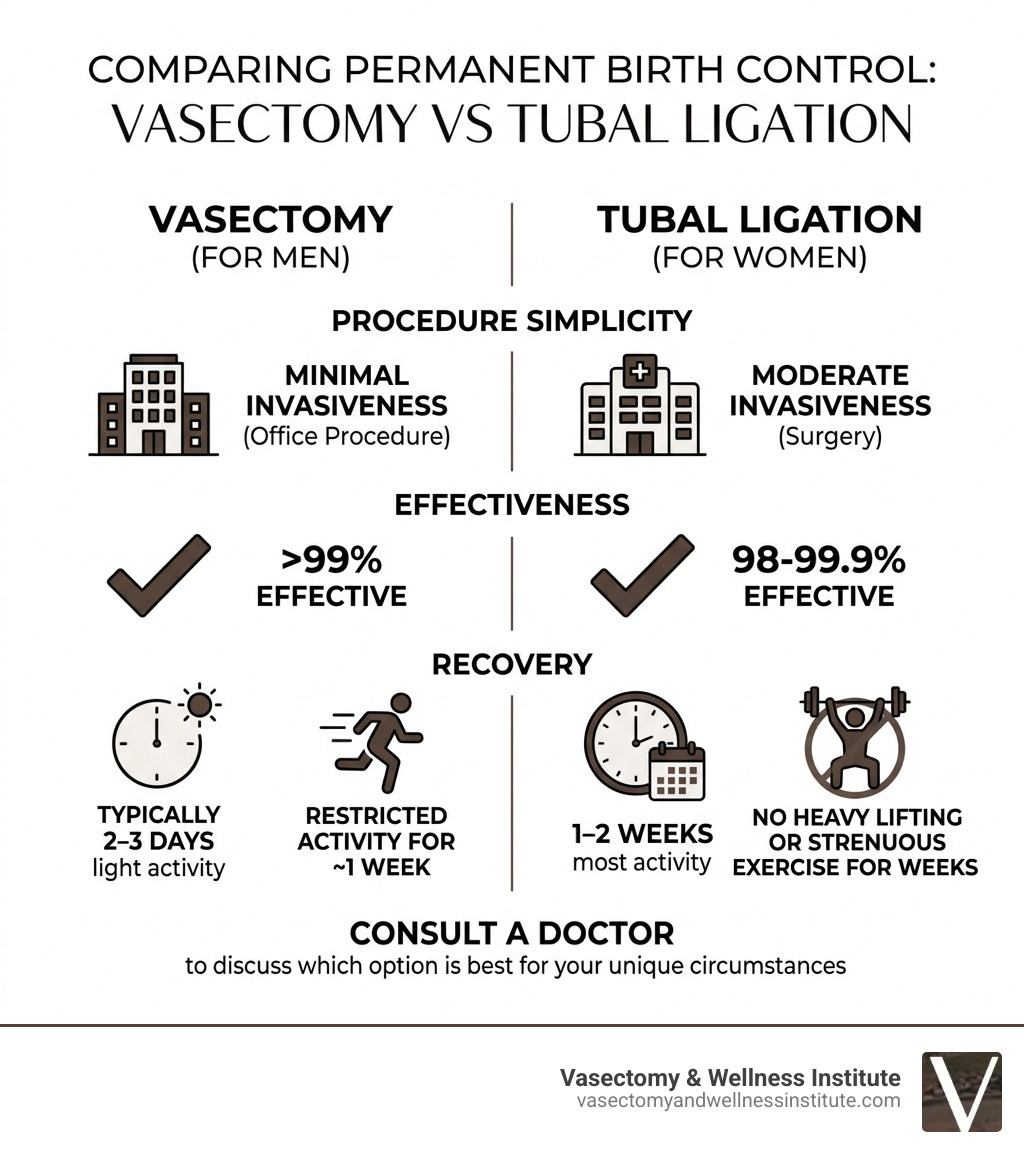
| Method | Who It’s For | Effectiveness | Invasiveness |
|---|---|---|---|
| Vasectomy | Men | >99% | Minimal (office procedure) |
| Tubal Ligation | Women | 98-99.9% | Moderate (surgery) |
| Bilateral Salpingectomy | Women | ~100% | Moderate (surgery) |
The short answer: If you and your partner are done having children, sterilization is the most reliable contraception available — more effective than any pill, IUD, or other reversible method.
Nearly a quarter of U.S. couples rely on sterilization as their primary form of contraception. It’s not a fringe choice — it’s the most common method of birth control in the country. Yet many people still have real questions: Which method is right for us? How permanent is permanent? Will it hurt?
Those are exactly the right questions to ask before making this decision.
This guide walks you through everything clearly — starting with the simplest, safest, and most overlooked option for couples: the vasectomy.
I’m Dr. Mustafa Ahmed MD, FACS, FAACS — a board-certified surgeon with experience in minimally invasive procedures, including permanent methods of birth control. My background in general and laparoscopic surgery gives me a strong foundation for helping men understand exactly what to expect from this decision, so you can move forward with confidence.
What is a Permanent Method of Birth Control?
When we talk about a permanent method of birth control, we are referring to sterilization. Unlike “reversible” methods—such as the pill, condoms, or even Long-Acting Reversible Contraception (LARC) like IUDs and implants—sterilization is intended to last for the rest of your life. It is a one-and-done solution for individuals or couples who are certain they do not want any more biological children.
The primary goal of any sterilization procedure is to create a physical barrier that prevents the egg and sperm from meeting. If they can’t meet, fertilization cannot occur. According to the Permanent Contraception | CDC, these methods are among the most effective forms of family planning available today.
The Main Types of Permanent Birth Control
In the United States, there are two primary paths to permanent sterilization:
- Male Sterilization (Vasectomy): A minor procedure where the vas deferens (the tubes that carry sperm) are blocked or cut.
- Female Sterilization (Tubal Ligation or Salpingectomy): Surgical procedures where the fallopian tubes are tied, clipped, or removed entirely.
While both paths achieve the same goal, the “how” and “where” differ significantly. Female procedures often require general anesthesia and a hospital or surgical center setting. In contrast, male-led solutions like the vasectomy are frequently performed in a comfortable office setting under local anesthesia. For many couples in April 2026, the simplicity of the male-led option makes it the preferred starting point for the conversation.
Vasectomy: The Gold Standard for Permanent Birth Control

If you are looking for the most efficient permanent method of birth control, the vasectomy stands out as the gold standard. It is a simple, safe, and nearly 100% effective procedure designed to prevent sperm from entering the ejaculate.
At our clinic in Henderson, Nevada, we specialize in the No-Needle, No-Scalpel Vasectomy: A Low-Stress Option. This modern approach is a far cry from the surgical “operations” of the past. By utilizing a No Knife, No Problem: The Complete Guide to NSV, we offer a technique that minimizes discomfort and maximizes peace of mind.
How a Vasectomy Works as a Permanent Method of Birth Control
To understand a vasectomy, you first have to understand how the plumbing works. Your body continues to produce sperm in the testicles. This sperm travels through two small tubes called the vas deferens to mix with other fluids to create semen.
During a vasectomy, we simply interrupt those tubes. We use a local anesthetic to numb the area—and with our no-needle technique, even the numbing process is virtually painless. Once the area is numb, we make a tiny puncture (not a cut) to access the vas deferens, which are then sealed.
It is important to note that a vasectomy does not change your hormones, your sex drive, or the way an orgasm feels. You still produce the same amount of ejaculate; the only difference is that the “passengers” (the sperm) are no longer on board. Scientific research on vasectomy effectiveness shows a failure rate of only about 0.15% in the first year, making it significantly more reliable than almost any other method.
Recovery and Confirming Sterility
One of the biggest advantages of a modern vasectomy is the quick turnaround. Most men find that they can return to a desk job within 2 to 3 days and resume normal exercise and sexual activity within a week. We provide a Detailed Guide to Vasectomy Recovery to help you navigate those first few days with ease.
However, there is one critical rule: Sterility is not immediate.
After the procedure, there is still “sperm in the pipes” above the site where the tubes were sealed. It generally takes about 12 weeks or roughly 20 ejaculations to clear out the remaining sperm. To confirm that the permanent method of birth control is fully active, you must undergo a semen analysis. We ask our patients to provide a sample to ensure a zero sperm count before they stop using other forms of contraception. Following A Comprehensive Guide to Vasectomy Recovery Times ensures you don’t have any “surprises” during the transition period.
Comparing Permanent Methods: Why Vasectomy is the Simpler Choice

When a couple decides they are done having children, the decision often falls between a vasectomy for the man or tubal ligation for the woman. While both are effective, they are not created equal when it comes to risk, recovery, and invasiveness.
Why Vasectomy is the Preferred Choice for Couples
For many families, the vasectomy is the logical choice because it is a much less invasive procedure. Consider these key differences:
| Feature | Vasectomy (Male) | Tubal Ligation (Female) |
|---|---|---|
| Anesthesia | Local (awake) | General (asleep) |
| Location | Doctor’s Office | Hospital/Surgical Center |
| Procedure Time | 20-30 Minutes | 1-2 Hours |
| Recovery Time | 2-3 Days | 1-2 Weeks |
| Major Risks | Very Low (<1%) | Low but higher (Infection, organ damage) |
Choosing a male-centered procedure often reduces the overall “family recovery time.” Instead of the mother undergoing abdominal surgery that might limit her ability to lift children or perform daily tasks for a week or more, the father can typically recover over a long weekend.
Understanding the Landscape of Sterilization
The safety and efficiency of the no-scalpel method have changed the landscape of sterilization. In the past, the fear of “going under the knife” kept many men away. Today, with minimally invasive techniques, the procedure is often described as being less stressful than a routine dental cleaning.
Furthermore, statistics show that tubal ligation has a failure rate that is roughly five times higher than that of a vasectomy in some contemporary studies. While both are incredibly safe, the simplicity of blocking the vas deferens versus entering the abdominal cavity to block fallopian tubes makes the vasectomy the safer medical bet for the couple as a unit.
Frequently Asked Questions
Is permanent birth control reversible?
The word “permanent” is used for a reason. While a vasectomy reversal is surgically possible, it is a much more complex, expensive, and difficult procedure than the original vasectomy. Success is never guaranteed and depends on how many years have passed since the original procedure.
We always advise our patients to go into the procedure with the mindset that it is irreversible. If you are feeling unsure, you might want to explore Beyond the Reversal: Other Ways to Start a Family or consider long-acting reversible options (like an IUD) until you are 100% certain.
Does sterilization protect against STIs?
No. This is a common misconception. A permanent method of birth control is designed solely to prevent pregnancy. It does not provide any protection against sexually transmitted infections (STIs), including HIV. If you have multiple partners or are concerned about infections, the consistent use of condoms and other barrier methods remains essential.
Does a vasectomy affect sexual performance?
Absolutely not. This is perhaps the most common myth we debunk at the Vasectomy & Wellness Institute. A vasectomy does not touch the parts of your body responsible for testosterone production, libido (sex drive), or the mechanics of an erection.
In fact, many couples report that their sex lives improve after a vasectomy because the “fear factor” of an unplanned pregnancy is removed. You can rest comfortably knowing that your masculinity and performance remain entirely intact—you’re just “firing blanks.”
Conclusion
Choosing a permanent method of birth control is a major life decision, but it doesn’t have to be a stressful one. By opting for a vasectomy, you are choosing a path that is safe, highly effective, and involves minimal downtime.
At the Vasectomy & Wellness Institute in Henderson, Nevada, we are committed to providing expert care in a comfortable environment. Our no-needle, no-scalpel technique is designed to get you back to your life quickly, without the stress of traditional surgery. If you’re ready to take the next step toward a worry-free future, we invite you to learn More info about our services and see why so many men in the Las Vegas area trust us with their wellness.