

What You Need to Know About Vasectomy Health Risks
Vasectomy health risks are a top concern for men considering permanent birth control — and understandably so. Here’s the short answer:
Quick Summary: Are Vasectomies Safe?
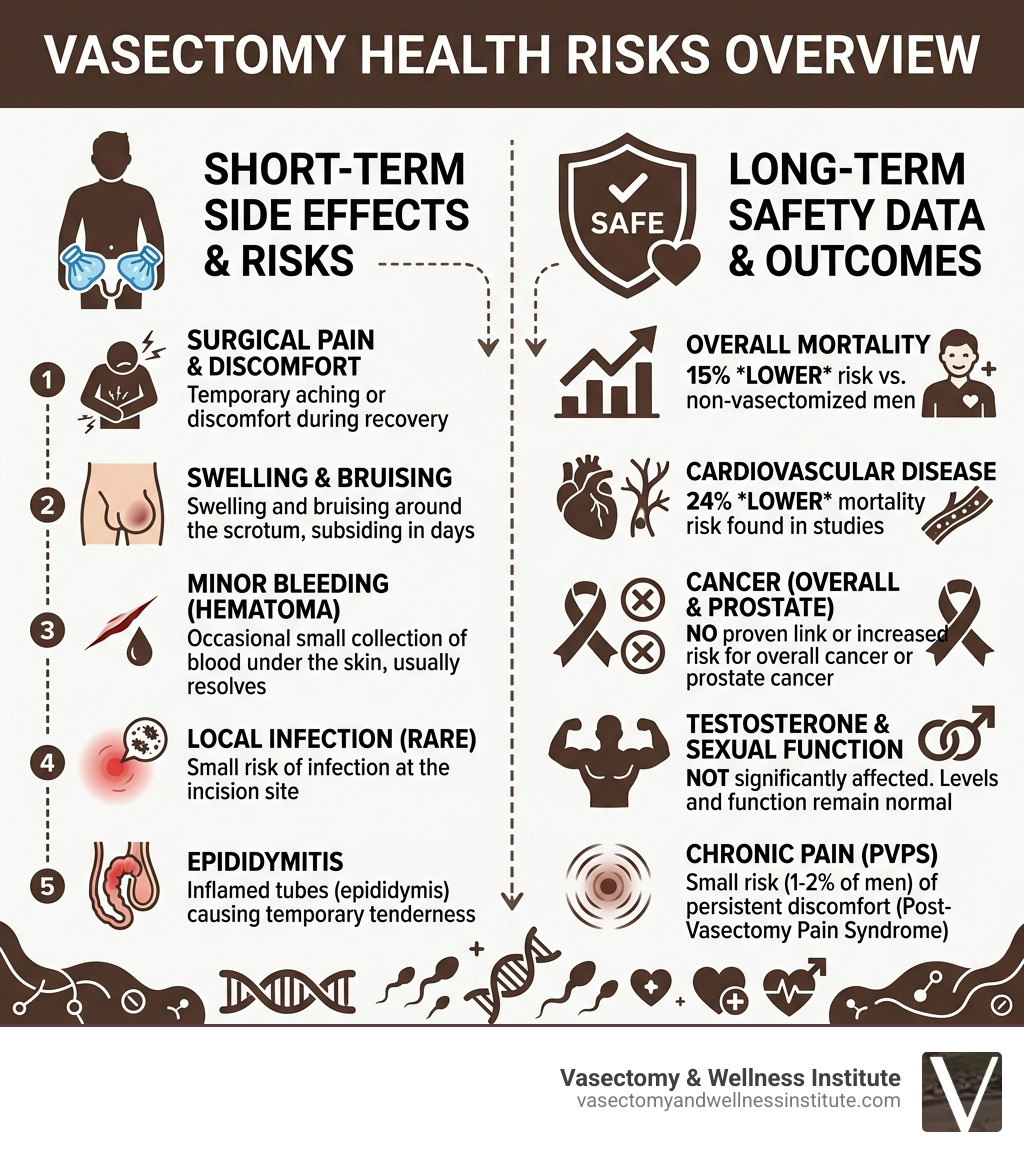
| Health Concern | What the Evidence Shows |
|---|---|
| Overall mortality | 15% lower risk vs. non-vasectomized men |
| Cardiovascular disease | 24% lower mortality risk |
| Cancer (overall) | No increased risk |
| Cancer (20+ years post-op) | Small increased risk, mainly lung cancer |
| Prostate cancer | No proven link |
| Heart disease | No association found |
| Sexual function | Not affected |
| Testosterone levels | Not significantly affected |
| Chronic scrotal pain (PVPS) | Affects 1-2% of men |
The bottom line: vasectomy is a safe, well-studied procedure. The vast majority of men experience no serious long-term health consequences. That said, there are real short-term side effects and a small number of longer-term risks worth understanding before you decide.
About 500,000 men have a vasectomy in the U.S. each year — and over 15% of American men over 40 have already had one. Yet questions and myths about long-term health effects persist. This guide cuts through the noise with evidence-based answers.
I’m Dr. Mustafa Ahmed MD, FACS, FAACS, a board-certified surgeon with specialized training in minimally invasive procedures and extensive clinical experience evaluating vasectomy health risks as part of comprehensive male wellness care. In the sections below, I’ll walk you through everything the research actually shows — from immediate surgical risks to long-term outcomes.
Immediate Surgical Risks and Side Effects

When we talk about vasectomy health risks, we usually start with the immediate aftermath of the procedure. While modern techniques have made the “snip” incredibly efficient—often taking just 15 to 30 minutes—it is still a surgical intervention.
Most men will experience some degree of mild bruising, swelling, and discomfort in the first few days. This is a natural part of the healing process. However, there are specific clinical complications that can occur:
- Hematoma: This occurs when blood collects under the skin, causing painful swelling. Research suggests the incidence of hematoma is around 2%, though this rate drops significantly when the procedure is performed by an experienced surgeon.
- Infection: Any time the skin is breached, there is a risk of infection. Symptoms include fever, redness, and tenderness. While generally rare (3-4%), we take every precaution to ensure a sterile environment to mitigate this risk.
- Sperm Granuloma: These are small, pea-sized lumps that form when sperm leaks from the cut end of the vas deferens into the surrounding tissue. They are usually harmless and often resolve on their own, though some may require anti-inflammatory medication.
- Initial Pain: You might feel a “pulling” sensation or a dull ache. Following a Detailed Guide to Vasectomy Recovery is the best way to manage these early symptoms.
It is important to note that the Complications of a vasectomy – NHS guidelines emphasize that while these risks exist, they are typically minor and easily managed with proper rest and icing.
Understanding Long-Term Vasectomy Health Risks

The question of what happens 10, 20, or 30 years down the line is what most of our patients in Henderson are curious about. One of the most interesting biological responses to a vasectomy is the development of antisperm antibodies.
Because the body continues to produce sperm that can no longer exit the body, the immune system eventually begins to “clean up” these cells. In up to two-thirds of men, the immune system develops antibodies to recognize these sperm cells. For decades, researchers wondered if this immune response could lead to systemic issues like autoimmune diseases. However, extensive long-term studies have provided massive reassurance.
The 20-Year Milestone: What Changes?
Research has looked closely at how the time since the procedure affects health outcomes. A landmark study involving over 14,000 men found some fascinating trends regarding vasectomy health risks over time.
| Time Since Procedure | Cardiovascular Mortality | Cancer Mortality | Overall Mortality |
|---|---|---|---|
| < 20 Years | 24% Reduction | No Association | 15% Reduction |
| ≥ 20 Years | No Association | 44% Increase (see below) | No Association |
The “44% increase” in cancer mortality after 20 years sounds scary, but it requires context. The study noted this was primarily driven by lung cancer in heavy smokers, suggesting that lifestyle factors (confounders) may have played a larger role than the procedure itself. Furthermore, overall mortality remained lower or equal to the general population. You can read more about the nuances of healing in our article on How Long It Really Takes to Heal After Getting Snipped.
For a deeper dive into the clinical data, the Review of Vasectomy Complications and Safety Concerns – PMC provides a comprehensive look at how the body adapts over several decades.
Evaluating Vasectomy Health Risks and Prostate Cancer
One of the most persistent myths is the link between vasectomy and prostate cancer. We want to be very clear here: modern medical consensus finds no proven link.
While some older studies suggested a weak correlation, larger and more recent systematic reviews have debunked this. Organizations like MD Anderson point out that men who have vasectomies are often more proactive about their health and see their urologists more frequently, leading to a higher rate of detection rather than a higher rate of disease.
If you are concerned, we recommend staying up to date with Vasectomy and prostate cancer risk: What you should know to see why the “link” has largely been dismissed by the scientific community.
Vasectomy Health Risks and Cardiovascular Disease
In the late 1970s, some animal studies suggested that the immune response to sperm might accelerate atherosclerosis (hardening of the arteries). However, human data has completely contradicted this.
In fact, the large-scale retrospective cohort studies mentioned earlier actually found a 24% reduction in cardiovascular mortality among vasectomized men. While we don’t claim that a vasectomy makes your heart “stronger,” this data likely points to a “healthy-worker effect” or selection bias—meaning men who choose elective procedures like a vasectomy often have better baseline health and more stable lifestyles than those who don’t.
Chronic Scrotal Pain and Post-Vasectomy Pain Syndrome (PVPS)
While long-term systemic diseases are not a major concern, we must discuss Post-Vasectomy Pain Syndrome (PVPS). This is defined as chronic scrotal pain that lasts for more than three months and is severe enough to interfere with daily activities.
- Prevalence: It affects approximately 1% to 2% of men.
- Causes: It can be caused by nerve irritation, back-pressure in the epididymis, or localized inflammation from a granuloma.
- Treatment: Most cases are managed with anti-inflammatory medications or physical therapy. In very rare instances, a surgical revision or reversal may be considered to alleviate the pressure.
We always tell our patients: Don’t Be a Hero: Expert Advice for Faster Healing. If you experience persistent pain beyond the normal recovery window, it is vital to speak with us so we can address it early. You can also find a breakdown of these side effects at 10 Risks and Side Effects of a Vasectomy to Know About – GoodRx.
Debunking Common Misconceptions
Let’s tackle the “locker room” talk. Many men worry that the snip will change who they are. Here are the facts:
- Testosterone: A vasectomy does not change your hormone levels. Your testicles continue to produce testosterone just as they did before.
- Libido and Sex Drive: Your desire for sex is hormonal and psychological; it is not tied to the “plumbing” of the vas deferens. Many couples actually report improved sex lives because the fear of unintended pregnancy is gone.
- Erectile Dysfunction: There is absolutely no physical link between a vasectomy and ED. The nerves and blood vessels required for an erection are not touched during the procedure.
- Semen Appearance: Sperm only accounts for about 5% of your total ejaculate volume. You won’t notice a difference in the look, feel, or amount of fluid.
Modern techniques have made the process even more approachable. Our No Knife, No Problem: The Complete Guide to NSV explains how the no-scalpel method reduces trauma to the tissue, further protecting your sexual wellness. You can also see more on this at the Vasectomy – Mayo Clinic page.
Frequently Asked Questions about Vasectomy Safety
Does a vasectomy increase the risk of autoimmune disease?
No. While it is true that men develop anti-sperm antibodies, there is no evidence that this leads to systemic autoimmune conditions like lupus or rheumatoid arthritis. The immune response is localized and specific to the sperm cells.
Can the vas deferens grow back together?
This is called recanalization. It is extremely rare, occurring in less than 1% of cases. Most failures happen in the first few months, which is why we insist on a follow-up semen analysis to confirm you are “clear” before you ditch other forms of birth control.
Does age at the time of procedure affect health outcomes?
The main “risk” associated with age is regret. Men under 30 are statistically more likely to seek a reversal later in life. From a physiological standpoint, however, health outcomes remain excellent across all age groups, provided the patient is in good baseline health.
Conclusion
At the Vasectomy & Wellness Institute in Henderson, Nevada, we believe that being informed is the best way to feel confident in your healthcare decisions. The data is clear: when it comes to vasectomy health risks, the procedure is remarkably safe, with a safety profile that compares favorably to almost any other form of permanent contraception.
We specialize in the no-needle/no-scalpel technique, which is designed to be a quick, low-stress experience with a faster recovery than traditional methods. If you’re ready to take the next step toward permanent birth control with affordable expert care, we are here to help.