

The Real State of Male Contraceptive Methods in 2026
Male contraceptive methods have barely changed in decades — and that gap matters more than most people realize.
Here is a quick overview of what is available right now and what is coming:
| Method | Type | Effectiveness (Typical Use) | Reversible? | STI Protection? |
|---|---|---|---|---|
| External condom | Barrier | ~80% | Yes | Yes |
| Spermicide (alone) | Chemical | 70-80% | Yes | No |
| Withdrawal | Behavioral | ~78% | Yes | No |
| Vasectomy | Permanent | >99% | Rarely | No |
| NES/T gel | Hormonal (in trials) | In development | Yes | No |
| YCT-529 pill | Non-hormonal (in trials) | In development | Yes | No |
Right now, most men are choosing between condoms and vasectomy — that is essentially it. No male pill. No male emergency contraception. No reversible hormonal option on the market yet.
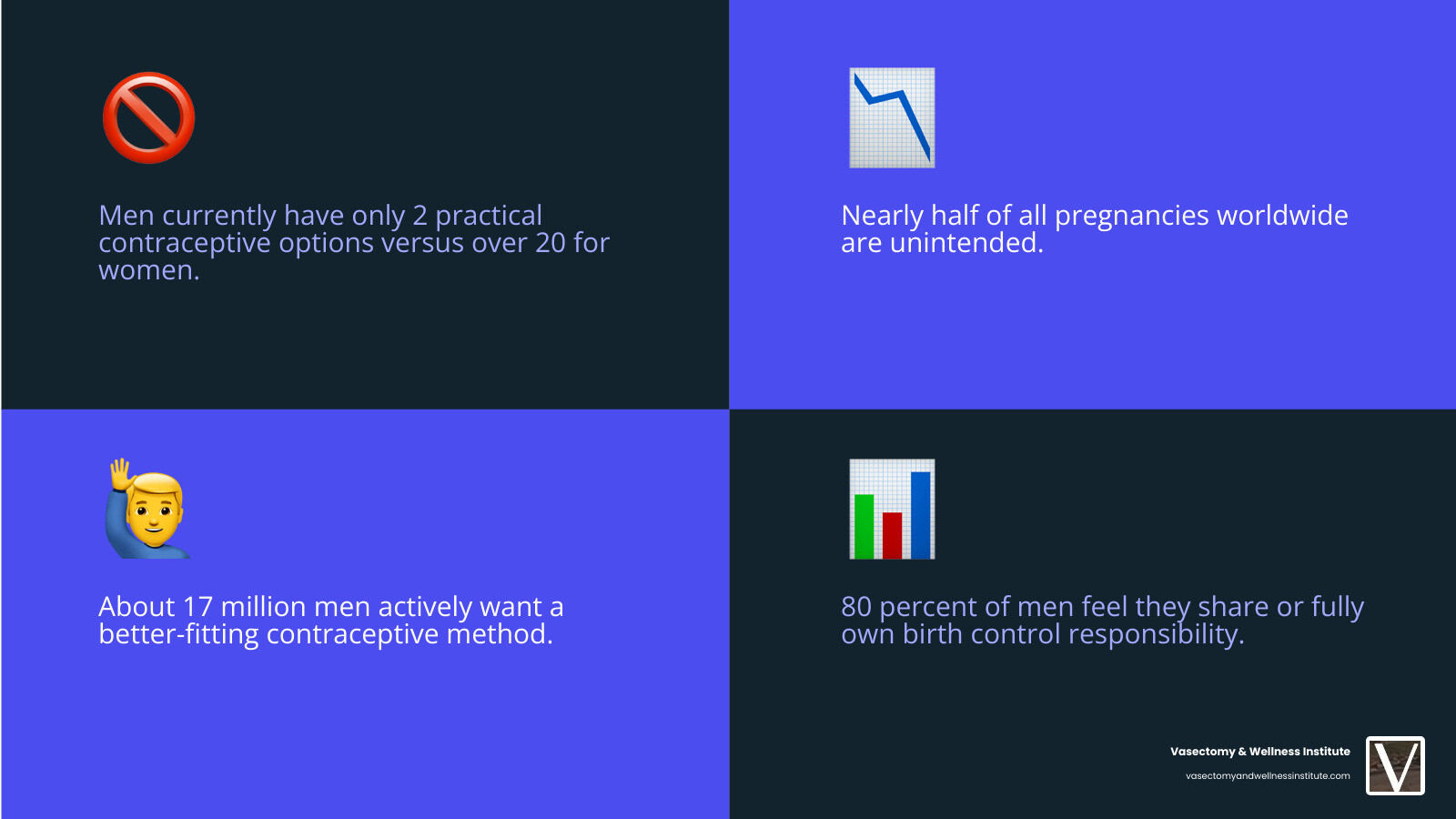
That is a striking imbalance. Women have over 20 FDA-approved contraceptive categories to choose from. Men have two practical options.
Meanwhile, nearly half of all pregnancies worldwide are unintended. And research shows that about 17 million men actively want a contraceptive option that better fits their lives — with 80% feeling they share or fully own the responsibility of birth control.
The landscape is changing, but slowly. New hormonal gels, injectable compounds, and hormone-free pills are moving through clinical trials. Some are closer than others. Understanding where things stand today — and where they are headed — helps you make a smarter, more informed decision for yourself and your partner.
I’m Dr. Mustafa Ahmed MD, FACS, FAACS, a board-certified surgeon with experience in minimally invasive procedures and a deep clinical interest in male contraceptive methods and men’s reproductive health. My background across internal medicine, surgery, and critical care gives me a grounded, evidence-based perspective on helping men navigate their options with confidence.
Male Contraceptive Methods Available Right Now
When we look at the menu of male contraceptive methods available in 2026, it can feel a bit like looking at a diner menu that only serves breakfast. We have a few reliable staples, but if you are looking for a three-course dinner (like a reversible, long-acting pill), you might be waiting a while.
Currently, men have four primary paths: barrier methods (condoms), chemical barriers (spermicide), behavioral methods (withdrawal), and permanent sterilization (vasectomy). Each has its own “perfect use” versus “typical use” stats. Perfect use is what happens in a lab; typical use is what happens on a Saturday night after a couple of drinks.
Condoms: the most common of today’s male contraceptive methods
The external condom remains the MVP of the contraceptive world for one reason: it is the only method on this list that protects against both pregnancy and STIs. When used perfectly, condoms are 98% effective. However, in the real world, that number often drops to around 82% to 87% due to breakage, slipping, or—most commonly—not putting it on soon enough.
For the best results, we always recommend:
-
- Storing them in a cool, dry place (the friction and heat of a wallet can degrade the latex).
-
- Checking the expiration date.
-
- Using only water- or silicone-based lubricants, as oil-based products can dissolve latex.
Spermicide and spermicide condoms: where they help and where they fall short
Spermicide, usually containing Nonoxynol-9 (N-9), works by creating a chemical barrier that kills sperm or stops them from moving. Used alone, it is only 70% to 80% effective, which is why we rarely recommend it as a primary method.
Many condoms come pre-lubricated with spermicide, but research suggests these don’t actually offer much extra protection over regular condoms. In fact, they may expire sooner and can cause irritation or even increase the risk of infection in some partners. If you use spermicide, remember it usually requires 10–15 minutes to “activate” before intercourse.
Withdrawal and outercourse: why behavior-based methods are less reliable
The withdrawal method, or “coitus interruptus,” is as old as time. While it is better than nothing, it has a typical failure rate of about 22%. The main risks are pre-ejaculate (which can contain active sperm) and the simple human error of not pulling away in time.
Outercourse—sexual activity that doesn’t involve vaginal penetration—is 100% effective at preventing pregnancy, but it still requires discipline and carries STI risks if there is skin-to-skin contact.
Vasectomy: the most effective long-term option
For those who are certain their family is complete, the vasectomy is the gold standard. It is a simple procedure where we block the vas deferens tubes, preventing sperm from entering the semen. It is over 99.9% effective, with only about 15 out of 10,000 couples experiencing a pregnancy in the year following the procedure.
It is important to remember that a vasectomy is not “instant.” You are not sterile the moment you leave our office. It typically takes about three months or 20–30 ejaculations to clear the remaining sperm from your system. We always perform a semen analysis at the three-month mark to confirm you are “all clear.”
If you are looking for a no-needle no-scalpel vasectomy, this is a low-stress, minimally invasive option that we specialize in here in Henderson. It is designed for permanent birth control without the long recovery times of traditional surgery.
Comparing Effectiveness, Tradeoffs, and STI Protection
Choosing between male contraceptive methods often involves a trade-off between convenience, effectiveness, and protection.
Which male contraceptive methods are best for pregnancy prevention?
If your primary goal is avoiding an unplanned pregnancy, the hierarchy is clear:
-
- Vasectomy: The most reliable, “set it and forget it” method.
-
- Condoms (Perfect Use): Highly effective but prone to user error.
-
- Withdrawal/Spermicide: High failure rates that make them risky as standalone options.
Pros and cons of each option
-
- Condoms: Great for STI protection and easy to find, but can interrupt the “mood” and reduce sensitivity.
-
- Spermicide: Adds a layer of protection but can cause skin irritation and has a low success rate alone.
-
- Withdrawal: Free and always available, but requires high self-control and offers no STI protection.
-
- Vasectomy: The most effective and cost-efficient over time, but it is a surgical procedure intended to be permanent.
What current methods do not solve
The biggest gap in current male contraceptive methods is the lack of a “middle ground.” We have the temporary barrier (condoms) and the permanent solution (vasectomy), but nothing in between like the pill or an IUD. This puts a disproportionate burden on women, who often deal with the side effects of hormonal birth control. With 17 million men interested in new options, the demand for a reversible, highly effective male pill or gel is at an all-time high.
Why New Male Contraceptive Methods Are Needed
The push for new male contraceptive methods isn’t just about convenience; it’s about reproductive equity. For decades, the responsibility for family planning has fallen largely on women. However, surveys show that over 55% of men across various cultures would accept a new male contraceptive, and up to 71% are willing to use one.
Demand from men and partners across cultures
Interestingly, the demand is even higher in some low-to-middle-income countries (LMICs) than in the U.S. In many cultures, men are increasingly eager to be equal partners in family planning. Women also overwhelmingly trust their partners; studies show only about 2% of women would not trust their partner to use a male contraceptive correctly.
Scientific and market barriers slowing progress
So, why don’t we have a male pill yet?
-
- Biology: Women release one egg a month. Men produce about 1,000 sperm every heartbeat. Stopping that “factory” is biologically more complex.
-
- The 74-Day Cycle: It takes about 74 days for sperm to be produced. This means any method that stops production takes months to work and months to reverse.
-
- Market Failure: Pharmaceutical companies have historically been hesitant to invest, fearing liability and low profit margins compared to female options.
For those interested in the technical side of these challenges, the WHO Target Product Profiles and the Endotext Male Contraception guide provide deep dives into the regulatory and biological hurdles we face.
Hormonal Male Contraceptive Methods in Development
Hormonal male contraceptive methods work similarly to the female pill by using hormones to signal the brain to stop production. Specifically, they target the Hypothalamic-Pituitary-Gonadal (HPG) axis to suppress the hormones (LH and FSH) that tell the testes to make sperm.
How hormonal male contraceptive methods work
The goal is to drop the sperm count to “severe oligozoospermia”—defined as less than 1 million sperm per milliliter of semen. At this level, the risk of pregnancy is extremely low, comparable to the efficacy of female hormonal methods.
Gels, pills, and injections in the pipeline
-
- NES/T Gel: This is a daily gel rubbed into the shoulders. It combines Nestorone (a progestin) with testosterone. In trials, it was 86% effective at reducing sperm production in 15 weeks or less.
-
- Testosterone Undecanoate (TU): A monthly injection that has shown high efficacy in trials, particularly in China, where it provided a failure rate of just 1.1 per 100 person-years.
-
- DMAU and 11β-MNTDC: These are “progestogenic androgens”—single compounds that do the work of two hormones. They are currently being tested as daily pills and long-acting injections.
Research on testosterone and male contraception and the current stage of hormonal knowledge shows that these methods are highly reversible, with sperm counts returning to normal within a few months of stopping.
Safety, efficacy, and reversibility compared with female hormonal methods
While effective, these methods can have side effects similar to the female pill, such as acne, mood changes, weight gain, or libido shifts. However, for many men, these are a small price to pay for taking control of their fertility.
Non-Hormonal Research That Could Change Male Birth Control
Many men are wary of hormones. That is where non-hormonal male contraceptive methods come in. These target the sperm directly or the specific proteins needed to make them, without messing with your testosterone levels.
The leading non-hormonal pill candidates
-
- YCT-529: This is a first-of-its-class, hormone-free pill that targets a Vitamin A receptor (RAR-alpha) essential for sperm production. In animal studies, it was 99% effective in preventing pregnancy and was fully reversible. It has already moved into human clinical trials. You can read more about the RARα-selective antagonists research to see how this molecular targeting works.
Other non-hormonal strategies under study
Scientists are looking at “sperm swimmers”—drugs that temporarily “paralyze” sperm so they can’t reach the egg. Targets include EPPIN, CatSper (a calcium channel), and sAC inhibitors. These could potentially be taken just hours before sex.
Vas deferens blocking approaches and other reversible ideas
Think of these as “reversible vasectomies.”
-
- RISUG/Vasalgel: A polymer gel is injected into the vas deferens to block sperm. It can be dissolved later with another injection to restore fertility.
-
- ADAM: A tiny hydrogel plug that blocks sperm and eventually dissolves or can be removed.
Preclinical studies, such as the evaluation of DMAU in primates, are helping us understand how long these “depot” methods can last and how safely they can be reversed.
Choosing the Right Option for Your Goals

When deciding between male contraceptive methods, you need to look at your “Five-Year Plan.”
Best fit for STI protection, temporary prevention, or permanent birth control
-
- Need STI protection? You must use condoms. No other method—current or future—protects against pathogens.
-
- Planning for kids in 2 years? Stick with condoms or look into the upcoming reversible gels once they hit the market.
-
- Done having kids? A vasectomy is the most logical, stress-free choice.
Questions to ask before deciding on a vasectomy
Before you “get the snip,” ask yourself:
-
- Is my partner on board with this being a permanent decision?
-
- Am I okay with using backup birth control for the first three months?
-
- Do I understand that while reversal is possible, it is not guaranteed?
If you’re in Nevada, we can help you navigate these questions and explain where you can get a vasectomy in the Henderson area.
What if you want children later?
If you think you might want children in the future, a vasectomy is generally not the right choice right now. While we can perform vasectomy reversals, they are complex surgeries and don’t always result in a pregnancy.
We always encourage men to consider vasectomy health risks and look into other ways to start a family if they are on the fence about permanence.
Frequently Asked Questions About Male Contraceptive Methods
Can men take emergency contraception after sex?
No. There is no “Male Plan B.” If a man takes emergency contraception designed for women, it will have no effect on his sperm or the likelihood of pregnancy. Emergency contraception must be taken by the female partner.
How long after a vasectomy are you actually sterile?
Usually three months. You need to clear out the “pipes.” We recommend at least 20 to 30 ejaculations during this period, and you must use a backup method until we give you the official “all clear” after a semen analysis.
Will partners trust men to use new birth control correctly?
The data says yes. In studies, over 90% of women said they would trust their partner to use a new male contraceptive method. Communication and shared responsibility are the foundations of modern family planning.
Conclusion
At the Vasectomy & Wellness Institute, we believe that men deserve better than “condoms and prayers.” Whether you are looking for the absolute reliability of a no-needle/no-scalpel vasectomy or you are following the exciting developments in hormonal gels and non-hormonal pills, staying informed is the first step toward taking control of your reproductive health.
The world of male contraceptive methods is finally expanding. While we wait for the FDA to approve the next generation of reversible pills and gels, we are here in Henderson to provide the most effective, expert care available today.
If you are ready to take the next step in your family planning journey, explore our services or schedule a consultation with us today. Shared responsibility starts with an informed choice.