

The Answer Most Men Get Wrong About Vasectomy and Unprotected Sex
How long after a vasectomy can you have unprotected sex is one of the most important questions to get right — and most men assume the answer is “a few days.” It’s not.
Here is the short answer:
| Stage | Timeline |
|---|---|
| Resume any sexual activity | 7–14 days after the procedure |
| Use backup birth control | Starting immediately after resuming sex |
| First semen analysis | 8 weeks post-procedure |
| Confirm sterility (azoospermia) | Typically 12 weeks post-procedure |
| Safe to have unprotected sex | Only after a doctor confirms zero sperm |
A vasectomy does not make you sterile on the day of surgery. Sperm can survive in the vas deferens for weeks — sometimes months — after the tubes are cut. Until a semen analysis confirms your sample is clear, unprotected sex carries a real risk of pregnancy.
This matters more than most men realize. The procedure itself takes about 15 to 30 minutes. But the road to truly unprotected sex takes roughly 3 months and at least 15 to 20 ejaculations to flush out remaining sperm — followed by a lab-confirmed semen test.
I’m Dr. Mustafa Ahmed MD, FACS, FAACS, a board-certified surgeon with experience in minimally invasive procedures and patient recovery across surgical disciplines — including helping men understand exactly how long after a vasectomy can you have unprotected sex safely. In the sections below, I’ll walk you through every stage of the timeline so you can protect your partner and make confident, informed decisions.
Resuming Sexual Activity: The Initial Recovery Timeline
When you undergo a vasectomy, your body needs time to heal before you introduce any physical friction or internal pressure to the reproductive tract. While the procedure itself is quick, the internal delicate tissues of the scrotum require a dedicated phase of rest.
In the first few days following your procedure, we advise prioritizing physical healing above everything else. This means wearing proper scrotal support, such as a snug jockstrap or tight compression shorts, and applying ice packs wrapped in a clean cloth to the area for 15 to 20 minutes at a time. For a deeper look at what to expect during these early days, you can read More info about healing times.
Why You Must Wait at Least 7 Days Before Any Sexual Activity
We understand that you might feel back to normal after just a couple of days, especially if you had a minimally invasive, no-scalpel procedure. However, we strictly require patients to wait at least 7 days before engaging in any sexual activity, including masturbation.
There are vital physiological reasons for this waiting period:
- Healing the Vas Deferens: The severed ends of the vas deferens need time to seal off securely.
- Sealing Blood Vessels: The tiny blood vessels surrounding the surgical site are still fragile.
- Preventing Hematomas: A hematoma is a painful collection of blood outside the blood vessels. The physical contractions of an orgasm can disrupt these delicate seals, causing internal bleeding and scrotal hematomas.
- Avoiding Severe Swelling: Ejaculating too early places sudden pressure on the healing reproductive tract, which can cause significant swelling and set your recovery timeline back by weeks.
The Risks of Having Sex Too Soon After a Vasectomy
Ignoring the one-week rule and rushing back into sexual activity can lead to painful complications. The body is highly sensitive during this initial recovery phase, and premature physical strain can cause:
- Epididymitis: This is the inflammation of the coiled tube (epididymis) at the back of the testicle that stores and carries sperm. When you ejaculate too soon, pressure waves can force fluids backward, leading to intense inflammation, swelling, and severe testicular pain.
- Incision Reopening: The small puncture or incision sites on your scrotum can easily pull apart under the friction of intercourse, opening a pathway for bacteria and increasing the risk of infection.
- Sperm Granulomas: If sperm leaks from the cut end of the vas deferens into the surrounding tissue before it has fully sealed, your immune system will treat the sperm as foreign invaders. This forms a hard, sometimes painful lump known as a sperm granuloma.
To learn more about what to expect as your body heals, you can read this guide on Back to Normal After a Vasectomy: How Long Does Recovery Really Take? as well as our detailed More info about recovery guidelines.
How Long After a Vasectomy Can You Have Unprotected Sex?
The most critical concept to understand after your vasectomy is that physical recovery does not equal sterility. You might feel 100% healed, have zero pain, and be enjoying a completely normal sex life with your partner, but you are still highly fertile.
Until your urologist officially clears you, any sexual encounter without a backup method of birth control carries a high risk of an unplanned pregnancy. You must continue using condoms, birth control pills, or another reliable contraceptive method. For more details on this transition period, check out More info about the effectiveness timeline.
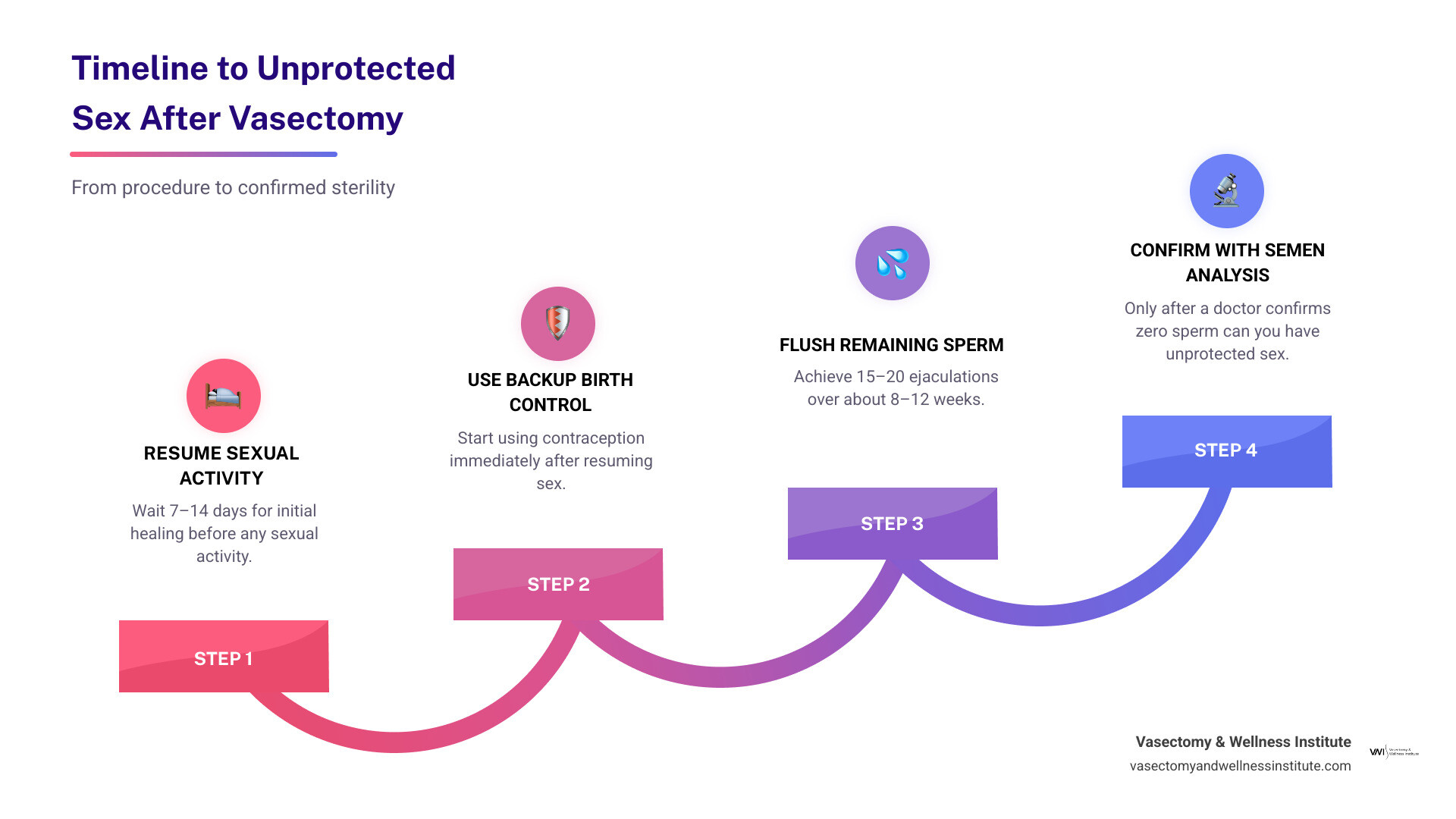
To help visualize this journey, we have outlined the distinct phases below:
Clearing the Pipes: Ejaculation Count and Sperm Clearance
Why does it take so long to become sterile after the vas deferens is cut? The answer lies in your anatomy. A vasectomy blocks new sperm from traveling from your testicles to your urethra, but it does nothing to the sperm that were already “in the pipeline” upstream of the cut site at the moment of your surgery.
These remaining sperm are highly viable and can survive in your reproductive tract for weeks or even months. To clear them out, you must actively flush the system.
- It typically takes at least 15 to 20 ejaculations to clear the remaining sperm.
- This clearance process is not instant; it requires a combination of both time and frequent ejaculation to successfully empty the reservoirs.
- Relying on time alone without ejaculating will not clear the pipes, nor will ejaculating 20 times in the first week (which, as we discussed, will only cause painful inflammation!).
How Long After a Vasectomy Can You Have Unprotected Sex: The Role of Semen Analysis
Because every man’s body clears sperm at a different rate, you can never assume you are sterile based solely on the number of weeks that have passed or the number of times you have ejaculated. Some men are completely clear of sperm at 8 weeks, while others still have active, swimming sperm at 12 weeks or more.
The only way to answer the question of how long after a vasectomy can you have unprotected sex with absolute certainty is through a laboratory semen analysis. This test looks at your ejaculate under a microscope to confirm the complete absence of moving sperm (azoospermia).
Until you submit a sample and receive an official “all-clear” from our medical team, you must treat every sexual encounter as if you are fully fertile. For additional medical context on this process, you can read How Soon After a Vasectomy Can You Have Sex?.
The Post-Vasectomy Semen Analysis (PVSA): Your Ticket to Freedom
The Post-Vasectomy Semen Analysis (PVSA) is the single most important step of your entire vasectomy journey. It is your official “ticket to freedom” from the worry of unplanned pregnancies. Surprisingly, a significant percentage of men skip this final step because they feel fine and assume the procedure worked. This is a risky mistake that leads to “vasectomy babies.”
To ensure your procedure is a complete success, we follow strict clinical protocols. For a comprehensive look at these medical standards, you can review the Vasectomy: AUA Guideline (2026) – American Urological Association.
What is a Semen Analysis and Why is it Required Before Having Unprotected Sex?
A semen analysis is a simple laboratory test where you provide a semen sample (typically collected via masturbation at home or in a private room) to be evaluated under a microscope.
Our laboratory specialists look for two primary things:
- Sperm Count: The total number of sperm present in your sample.
- Sperm Motility: Whether any of the sperm are actively moving or swimming.
We typically schedule your first semen analysis between 8 and 12 weeks post-procedure. This timeline allows your body sufficient time to naturally clear out the remaining sperm cells. To read more about how this testing fits into your overall recovery, check out How Long After a Vasectomy Can You Have Sex: A Comprehensive Recovery Guide.
Understanding the AUA Guidelines for Sterility Verification
The American Urological Association (AUA) has established clear, evidence-based guidelines to determine when a patient can safely stop using backup birth control:
- Complete Azoospermia: The ideal result is complete azoospermia, meaning absolutely zero sperm are found in your semen sample.
- Rare Non-Motile Sperm: Under modern AUA guidelines, you can also be cleared if your sample shows fewer than 100,000 rare, non-motile (dead or non-moving) sperm per milliliter.
- The 2-Hour Window: To clear a patient based on the presence of rare non-motile sperm, the semen sample must be evaluated within 2 hours of collection. If the sample is older than 2 hours, we must see absolute azoospermia (zero sperm) to safely clear you.
- Persistent Motile Sperm: If active, swimming sperm are still present at your 3-month check, you will need to continue using backup protection and submit another sample in a few weeks. If motile sperm persist past 6 months, it may indicate that the vas deferens has spontaneously reconnected, and we will counsel you on the possibility of a repeat procedure.
Long-Term Expectations and Sexual Function Post-Vasectomy
It is completely normal to have questions about how a vasectomy will affect your sex life, your masculinity, and your overall physical performance in the long run. Fortunately, the medical consensus is clear: a vasectomy is a highly safe procedure that has zero negative impact on your sexual function. For a detailed breakdown of these long-term effects, you can read Sex After Vasectomy: Timeline, Effects on Erection and Ejaculate.
Does a Vasectomy Affect Sex Drive, Erections, or Ejaculation?
One of the most common myths is that a vasectomy will lower your testosterone levels, decrease your libido, or ruin your erections. This is anatomically impossible.
- Hormonal Balance: Your testicles produce testosterone, which is absorbed directly into your bloodstream. A vasectomy only cuts the vas deferens (the tube that carries sperm); it does not touch the blood vessels or glands responsible for hormone production. Your sex drive and energy levels will remain exactly the same.
- Erectile Function: The nerves and blood vessels that control erections are completely separate from the vas deferens. Your ability to get and maintain an erection is completely unaffected.
- Ejaculate Volume and Sensation: Sperm only accounts for about 2% to 5% of your total ejaculate volume. The vast majority of your semen is produced by your prostate and seminal vesicles, which are untouched during a vasectomy. Your ejaculate will look, taste, feel, and smell exactly the same, and your orgasms will remain just as intense.
In fact, many couples report that their sex lives actually improve after a vasectomy because the psychological anxiety of an unplanned pregnancy is completely removed!
Can a Vasectomy Fail Years Later and Allow Pregnancy?
A vasectomy is one of the most effective forms of permanent birth control available, boasting a success rate of over 99.8%. However, no surgical procedure is 100% foolproof.
In extremely rare cases, a vasectomy can fail due to a process called recanalization. This occurs when the body attempts to heal itself by growing microscopic new channels through the scar tissue, allowing sperm to bypass the cut and reunite the severed ends of the vas deferens.
- Most cases of recanalization occur within the first 12 weeks of recovery, which is why the post-vasectomy semen analysis is so vital.
- Spontaneous recanalization years after a confirmed clear semen analysis is extraordinarily rare, occurring in less than 1 in 2,000 cases.
Frequently Asked Questions About Post-Vasectomy Recovery
To help you navigate your recovery with confidence, we have answered some of the most common questions our patients ask. For a full list of questions, you can visit our More info about common questions page.
Does a vasectomy protect against sexually transmitted infections (STIs)?
No. A vasectomy only prevents pregnancy by blocking sperm from entering your semen. It does not protect against STIs such as HIV, chlamydia, gonorrhea, herpes, or HPV. Because these infections are transmitted through bodily fluids and skin-to-skin contact, you should continue to use condoms with new or untested partners.
What should you do if you experience pain or blood in semen after resuming sex?
It is not uncommon to experience a mild ache or notice a slight reddish-brown tint (blood) in your semen the first few times you ejaculate after your vasectomy. This is typically just residual blood from the healing process and is no cause for alarm.
However, you should contact our office immediately if you experience:
- Severe, worsening pain that is not relieved by over-the-counter pain medication.
- Significant swelling or a rapid increase in the size of your scrotum.
- A fever over 100.4°F (38°C), which can indicate an infection.
- Pus or active drainage from your puncture or incision site.
How long after a vasectomy can you have unprotected sex if you had a no-scalpel procedure?
Even if you undergo a modern, minimally invasive no-scalpel and no-needle vasectomy, the timeline to safely have unprotected sex remains exactly the same.
While a no-scalpel procedure offers a significantly faster and more comfortable physical recovery (often allowing you to return to light activities within a few days), it does not change the rate at which your body clears remaining sperm. You must still wait 8 to 12 weeks, complete 15 to 20 ejaculations, and obtain a confirmed clear semen analysis before engaging in unprotected sex.
Conclusion
At the Vasectomy & Wellness Institute in Henderson, Nevada, we are dedicated to providing men with the highest standard of expert urological care. We specialize in easy, painless, minimally invasive no-needle/no-scalpel vasectomy procedures designed to ensure a quick recovery and affordable expert care.
If you are ready to take control of your family planning and enjoy the ultimate peace of mind, we are here to guide you through every step of the process — from your initial consultation to your final, liberating semen analysis. Schedule your consultation today to get started on your journey.