

How Long Until a Vasectomy Actually Works?
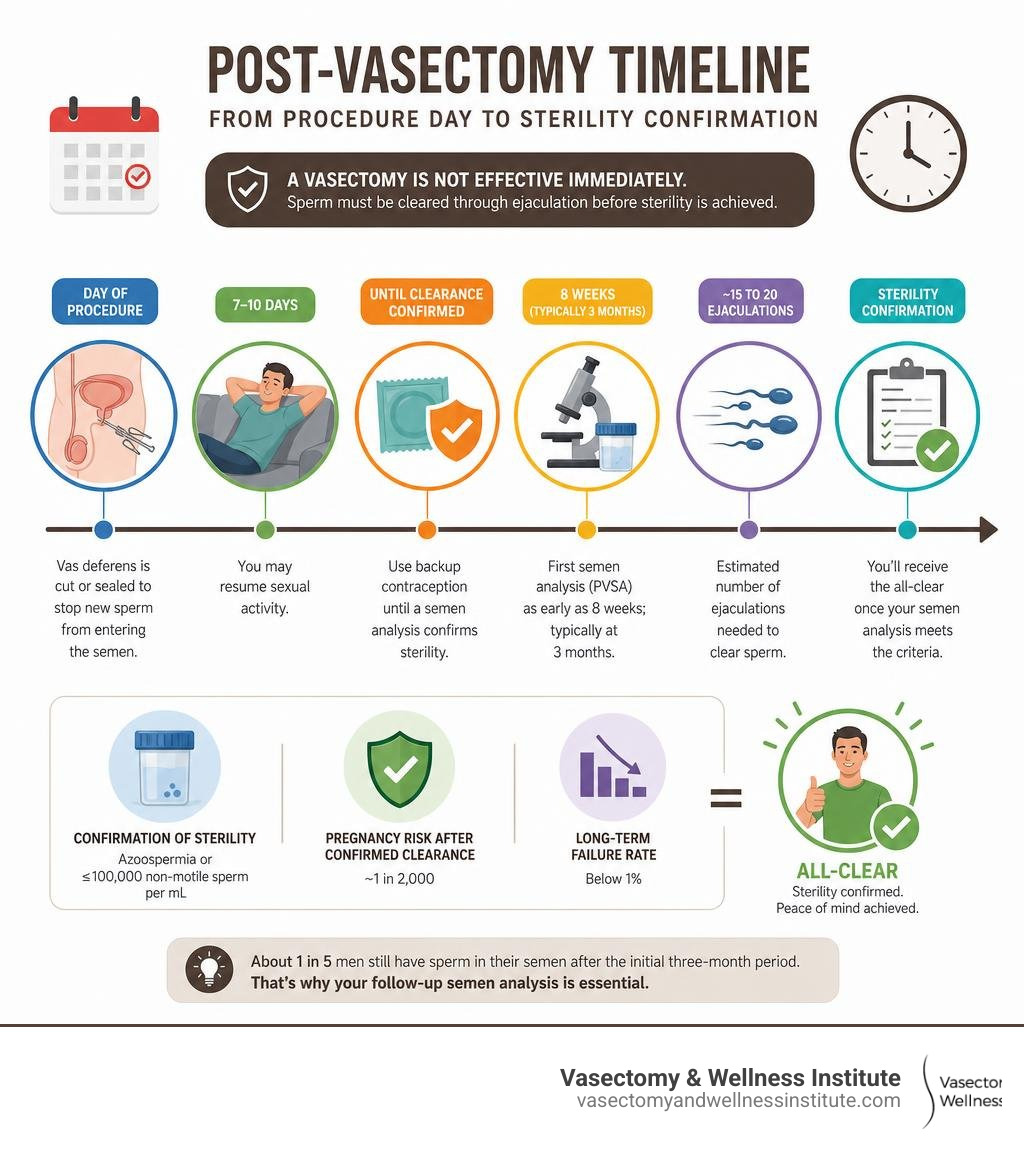
Understanding the vasectomy effectiveness timeline is the first thing any man should do before — or right after — getting the procedure. Here is the short answer:
| Milestone | Timeframe |
|---|---|
| Resume sexual activity | 7-10 days post-procedure |
| Use backup contraception | Until semen analysis confirms clearance |
| First semen analysis (PVSA) | As early as 8 weeks; typically 3 months |
| Ejaculations needed to clear sperm | ~15 to 20 |
| Confirmation of sterility | Azoospermia or ≤100,000 non-motile sperm per mL |
| Pregnancy risk after confirmed clearance | ~1 in 2,000 |
| Long-term failure rate | Below 1% |
A vasectomy does not work immediately. Sperm already present beyond the surgical site must be cleared through ejaculation before the procedure is effective. Most men reach that milestone around the three-month mark — but not all do, and a confirmed semen analysis is the only way to know for certain.
About 1 in 5 men still have sperm in their semen after the initial three-month period. That is why skipping your follow-up semen analysis is never a good idea.
I’m Dr. Mustafa Ahmed MD, FACS, FAACS, a board-certified surgeon with experience in minimally invasive procedures, and I’ve guided many patients through the nuances of the vasectomy effectiveness timeline to help them make confident, informed decisions. In the sections below, we’ll walk through every stage — from the day of your procedure to the moment you get the all-clear.
Understanding the Vasectomy Effectiveness Timeline

When we talk about the vasectomy effectiveness timeline, we are looking at the biological process of clearing out the “pipes.” During a vasectomy, we interrupt the vas deferens—the tubes that transport sperm from the testicles to the urethra. While this stops new sperm from entering the semen, it does absolutely nothing to the millions of active sperm that are already past the surgical cut, waiting in the upper portion of the vas deferens and seminal vesicles.
Think of it like shutting off the main water valve to your house. The moment you turn the valve, no new water enters the system. However, if you turn on a faucet, water will still run for a little while because of the residual liquid left in the pipes.
To clear this residual sperm, you need both time and physical clearance. The general clinical consensus is that it takes approximately 15 to 20 ejaculations, or roughly three months, to fully flush out the remaining sperm. However, this is not a one-size-fits-all rule.
In fact, a landmark Scientific research on time to azoospermia revealed that relying solely on a set number of ejaculations or a specific calendar date can be highly misleading. In that prospective study, only about 27.9% of men achieved complete azoospermia (zero sperm in the semen) after 20 ejaculations, and only 60% reached it by the 12-week mark. Furthermore, roughly 16.6% of participants still had lingering sperm at 24 weeks. This highlights why a formal laboratory check is the only reliable way to confirm you have reached the finish line.
Why the Vasectomy Effectiveness Timeline Requires Backup Contraception
Because of this biological delay, using a reliable backup method of birth control is non-negotiable during the initial recovery months. If you have unprotected sex before your doctor officially declares you sterile, there is a very high chance of an unplanned pregnancy.
The remaining sperm left in your active vas deferens are just as viable and capable of fertilization as they were before your surgery. In the first year after a vasectomy, a small number of couples still experience unplanned pregnancies because they stopped using backup contraception too early. To avoid this, we strongly emphasize keeping your preferred barrier or hormonal birth control methods active until we give you the final green light. For more context on how this compares to other permanent options, you can read More info about permanent birth control methods.
Factors That Influence Your Vasectomy Effectiveness Timeline
Several individual variables can either speed up or slow down your path to a zero sperm count:
- Ejaculation Frequency: Men who ejaculate more frequently after their initial healing window tend to clear out the residual sperm faster than those who do so less often.
- Surgical Technique: The specific method used to seal the vas deferens plays a massive role in long-term success and how quickly the body stabilizes. Modern guidelines, including the AUA Guideline (2026) on vasectomy standards, highlight that combining mucosal cautery (using heat to seal the inside of the tube) with fascial interposition (pulling a layer of surrounding tissue between the cut ends to create a physical barrier) dramatically reduces the risk of the tubes growing back together.
- Individual Anatomy: Every man’s body heals at a slightly different rate. Some individuals naturally have a larger storage capacity in their seminal vesicles, requiring more time and ejaculations to fully clear.
Confirming Sterility: Post-Vasectomy Semen Analysis (PVSA)

The only way to transition from “potentially fertile” to “officially sterile” is through a Post-Vasectomy Semen Analysis (PVSA). This is a simple laboratory test where we look at a sample of your semen under a microscope to check for the presence of sperm.
According to major urological standards, your first PVSA should be scheduled between 8 to 16 weeks after your procedure. During this analysis, we are looking for one of two outcomes to confirm success:
- Azoospermia: The complete absence of any sperm in the semen.
- Rare Non-Motile Sperm: The presence of fewer than 100,000 non-motile (dead or non-moving) sperm per milliliter of semen.
If your sample shows only a very small number of non-moving sperm (under the 100,000 per mL threshold), clinical studies show that the risk of pregnancy is virtually identical to having absolute zero sperm—roughly 1 in 2,000. However, if even a single moving (motile) sperm is detected, you will need to continue using backup birth control and submit another sample at a later date. For a deeper look at the clinical protocols surrounding this evaluation, you can explore the Clinical details on post-vasectomy semen analysis.
Resuming Sexual Activity and Collecting Your Sample
Before you can even think about collecting a sample for testing, your body needs time to heal from the surgery itself. We generally recommend a brief waiting period of 7 to 10 days before resuming any sexual activity or ejaculation. This protects the delicate healing tissues of the scrotum and prevents complications like bleeding or increased swelling.
Once you have crossed the 8-to-12-week mark and completed at least 15 to 20 ejaculations, it is time to collect your sample. For the most accurate results, you should collect the sample via masturbation directly into a sterile cup provided by the clinic or lab. It is crucial to avoid using lubricants or condoms that contain spermicides, as these can interfere with the analysis.
Additionally, the sample must be kept at room temperature and delivered to the testing laboratory within two hours of collection. If you want to prepare yourself for what to expect during the early recovery days leading up to this point, take a look at our Detailed guide to post-vasectomy recovery.
Vasectomy Failure Rates and Long-Term Effectiveness
One of the greatest benefits of a vasectomy is its unmatched reliability. Once you receive your official clearance, a vasectomy is nearly 100% effective at preventing pregnancy. However, like any medical procedure, it is important to understand the minor risks of failure and how they change over time.
Vasectomy failures generally fall into two categories:
- Early Recanalization: This occurs during the first few weeks or months of recovery. As the body heals, the severed ends of the vas deferens may attempt to find each other and sprout tiny new microscopic channels (often through a small inflammatory lump called a sperm granuloma), re-establishing a connection. This is why we perform the PVSA at 3 months. If early recanalization happens, it will show up on your semen analysis, and we can address it—sometimes requiring a repeat procedure, which occurs in about 0.24% of cases.
- Late Recanalization: This is an extremely rare phenomenon where the tubes reconnect years after a previously confirmed successful vasectomy. It occurs in roughly 1 in 2,000 men. It is usually caused by microscopic channels forming through scar tissue over a long period. While it cannot be entirely predicted, using advanced occlusion techniques like mucosal cautery with fascial interposition makes this risk incredibly low.
To put the effectiveness of a vasectomy into perspective, let’s look at how it stacks up against temporary barrier and hormonal methods:
| Contraceptive Method | Typical Use Failure Rate (First Year) | Perfect Use Failure Rate | Permanent? |
|---|---|---|---|
| Vasectomy (Post-Clearance) | <0.15% | <0.1% | Yes |
| Oral Contraceptive Pills | ~7% to 9% | 0.3% | No |
| Male Condoms | ~13% | 2% | No |
| No Contraception | ~85% | 85% | No |
Comparing Vasectomy to Temporary Barrier Methods
As the table shows, temporary barrier methods like male condoms carry a much higher real-world failure rate. This discrepancy is largely due to human error—forgetting to use a condom, physical breakage, or improper storage.
With a vasectomy, once you achieve clearance, the element of daily human error is completely removed. You do not have to stop in the middle of an intimate moment, and you do not have to remember to take a pill at the exact same time every day. If you are curious about the broader safety profile, long-term health outcomes, or potential side effects of the procedure, you can read more in our article about the Safety and health risks of vasectomy.
Frequently Asked Questions About Vasectomy Effectiveness
How long after a vasectomy are you sterile?
You are not sterile immediately after a vasectomy. On average, it takes about 3 months and 15 to 20 ejaculations to clear the remaining sperm from your reproductive tract. You are only considered officially sterile once a post-vasectomy semen analysis (PVSA) confirms either a zero sperm count or a rare, safe level of non-motile sperm.
Can a vasectomy fail after 10 years?
While incredibly rare, it is technically possible. This is known as late recanalization, where the severed ends of the vas deferens manage to grow back together and form a new connection through granulomatous or scar tissue years down the road. The risk of this happening after you have received a clean semen analysis is roughly 1 in 2,000.
What happens if my semen analysis still shows sperm after 6 months?
If your semen analysis continues to show active, moving (motile) sperm after 6 months, or if you have a persistently high concentration of non-motile sperm (over 100,000 per mL), it may indicate that the procedure has failed due to early recanalization. In these rare instances (about 0.24% of cases), we will discuss your options, which may include performing a repeat vasectomy to achieve complete sterility.
Conclusion
Navigating the vasectomy effectiveness timeline requires a little bit of patience, but the long-term peace of mind is well worth the wait. By understanding that the procedure takes time to become fully effective, staying committed to your backup contraception, and completing your follow-up semen analysis, you can ensure a seamless transition to worry-free intimacy.
At the Vasectomy & Wellness Institute in Henderson, Nevada, we specialize in making this journey as simple, comfortable, and stress-free as possible. We utilize advanced, minimally invasive, no-needle and no-scalpel techniques that minimize discomfort and accelerate your recovery. If you are ready to take control of your reproductive health with expert, compassionate care, we invite you to Schedule a consultation for men’s wellness services with us today.