

Why More Men Are Taking Charge of Birth Control
Contraception for guys has never been more relevant — and more men are paying attention.
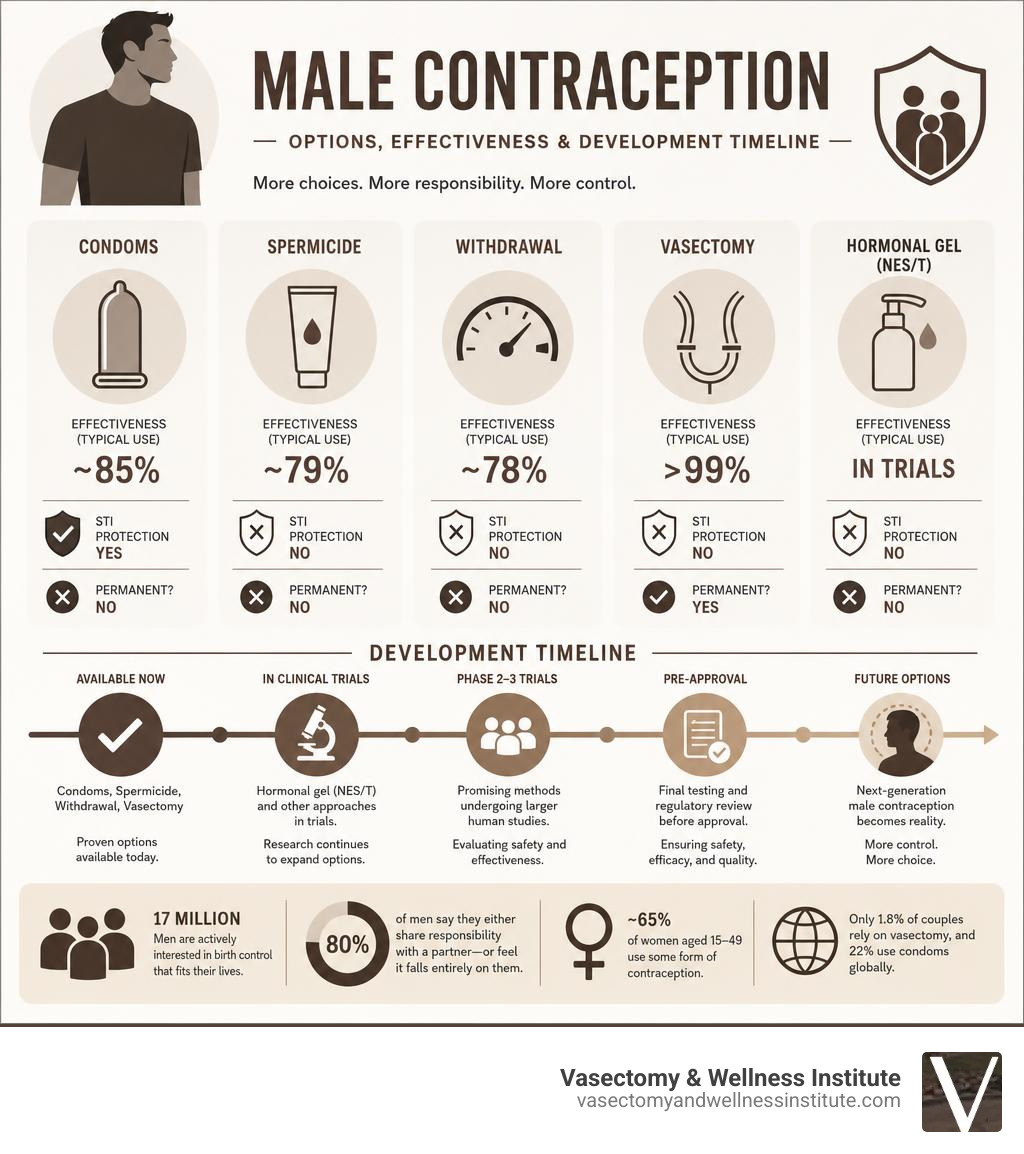
Here’s a quick look at the main options available right now:
| Method | Effectiveness (Typical Use) | Permanent? | STI Protection? |
|---|---|---|---|
| Condoms | ~85% | No | Yes |
| Spermicide | ~79% | No | No |
| Withdrawal | ~78% | No | No |
| Vasectomy | >99% | Yes | No |
| Hormonal gel (NES/T) | In trials | No | No |
An estimated 17 million men are actively interested in birth control that fits their lives. And 80% say they either share that responsibility with a partner — or feel it falls entirely on them.
Yet the numbers tell a different story. About 65% of women aged 15 to 49 use some form of contraception. Meanwhile, globally, only 1.8% of couples rely on vasectomy, and roughly 22% use condoms. The burden has historically landed on women — even though nearly 40% of pregnancies in the U.S. are unplanned.
That gap is starting to close. More men are asking questions, having conversations with their partners, and looking for options that are reliable, low-maintenance, and safe.
I’m Dr. Mustafa Ahmed MD, FACS, FAACS, a board-certified surgeon with experience across internal medicine, minimally invasive surgery, and men’s wellness — including contraception for guys who want effective, long-term solutions. In this guide, I’ll walk you through everything you need to make a confident, informed decision.
Why Contraception for Guys Matters Today
For decades, the cultural default has placed the contraceptive burden squarely on women. Whether it is navigating the daily schedule of oral contraceptives, scheduling appointments for intrauterine devices (IUDs), or managing systemic hormonal side effects, women have historically carried the weight of reproductive planning.
However, modern relationship dynamics are shifting. Men are increasingly eager to step up and share this responsibility. True family planning is a team effort, and finding the right lifestyle fit means evaluating options together. When men take an active role in pregnancy prevention, it not only strengthens partnership trust but also allows couples to make balanced health decisions that do not compromise one partner’s physical well-being.
Current Options for Contraception for Guys
When it comes to active contraception for guys, the options currently available on the market are relatively straightforward. Unlike the wide array of methods available to women, men have historically had to choose between temporary barrier methods and permanent surgical options.

To help navigate these choices, it is helpful to look at resources like the WebMD guide on male birth control options, which outlines how these methods function in real-world scenarios.
The Limitations of Temporary Methods: Condoms and Spermicides
For men looking for temporary, non-permanent birth control, the standard toolkit relies on condoms, spermicides, or the withdrawal method. While these options are highly accessible, they come with substantial real-world limitations.
-
- Condoms (The Barrier Method): If used perfectly every single time, external condoms are 98% effective. However, human error is a major factor. In real-world “typical use” scenarios, condom effectiveness drops to about 85%. This means that in a given year, roughly 15 out of every 100 couples relying solely on condoms will experience an unplanned pregnancy. The primary advantage of condoms remains their unmatched ability to protect against Sexually Transmitted Infections (STIs).
-
- Spermicides: Used on their own, spermicides are only about 70% to 80% effective. Typical use fails roughly 21% of the time. Even spermicide-lubricated condoms, which are designed to offer dual protection, only achieve about 87% effectiveness when factoring in typical user errors and accidents. Furthermore, spermicides do not protect against STIs and can sometimes cause localized irritation for either partner.
-
- The Withdrawal Method (Pulling Out): Despite being widely used, withdrawal is highly unreliable. With typical use, it fails roughly 22% of the time. This means nearly 1 in 5 couples relying on this method will face an accidental pregnancy over the course of a year.
Because temporary methods rely heavily on perfect execution during moments of intimacy, they carry a high risk of user error. For couples seeking peace of mind and long-term reliability, these temporary options often fall short.
Vasectomy: The Permanent Choice
For men who are certain that their family is complete, or who know they do not wish to have biological children, a vasectomy stands as the gold standard of male birth control.
A vasectomy is a highly straightforward, outpatient procedure that blocks sperm from entering the semen. It boasts an effectiveness rate of over 99%, making it one of the most reliable forms of birth control on the planet. In fact, only about 15 out of every 10,000 couples experience a pregnancy in the year following a successful vasectomy.
Unlike temporary barrier methods, a vasectomy eliminates the risk of user error entirely. To understand how this works as a long-term strategy, you can read our overview of permanent birth control methods, which explains the mechanics of surgical sterilization.
Understanding Vasectomy Recovery and Reversibility
If you are considering a vasectomy, it is entirely normal to have questions about the procedure itself, the recovery timeline, and what happens if your plans change in the future.

No-Needle, No-Scalpel Vasectomy Procedures
At the Vasectomy & Wellness Institute in Henderson, Nevada, we specialize in a modern, patient-friendly technique known as the no-needle, no-scalpel vasectomy (NSV).
Traditional vasectomies often involved surgical incisions, stitches, and the anxiety-inducing pinch of a local anesthetic needle. Our advanced approach replaces these steps with a far gentler process:
-
- No-Needle Anesthesia: We utilize an advanced spray applicator that delivers local anesthesia through the skin without a single needle poke.
-
- No-Scalpel Access: Instead of cutting the scrotal skin, we use a specialized tool to make a tiny, microscopic puncture. Through this single point, we gently access and seal the vas deferens tubes.
-
- Rapid Healing: Because the opening is so small, it naturally seals itself without the need for stitches.
This minimally invasive technique drastically reduces discomfort, minimizes the risk of bruising or bleeding, and allows for an incredibly fast recovery. To learn more about how this low-stress procedure works, check out our guide on no-needle, no-scalpel vasectomy options.
Post-Procedure Care and Confirming Sterility
One of the most critical aspects of getting a vasectomy is understanding that sterility is not immediate. After the procedure, active sperm remain upstream in the vas deferens. It takes time and regular ejaculation to clear these remaining cells from your system.
-
- The Recovery Window: Most men can return to light office work within a day or two. However, we advise avoiding strenuous exercise, heavy lifting, and sexual activity for about a week to let the tissues heal completely. For a closer look at what to expect day-by-day, read our detailed guide to vasectomy recovery and learn more about how long it takes to heal after getting snipped.
-
- The Clearance Phase: You must continue using an alternative form of birth control immediately after your procedure. Typically, it takes about 20 to 30 ejaculations (or roughly 2 to 3 months) to clear the remaining sperm.
-
- The Semen Analysis: Before you can safely stop using backup contraception, you must submit a semen sample for laboratory analysis. Only when a doctor confirms a zero sperm count (or a safe level of completely immobile sperm) are you officially cleared to rely on your vasectomy as your sole method of birth control.
Reversing a Vasectomy: What You Need to Know
While a vasectomy should always be approached as a permanent decision, life can take unexpected turns. Relationships change, and some men eventually decide they want to restore their fertility.
A vasectomy reversal is a delicate microsurgical procedure that reconnects the severed ends of the vas deferens. While reversals are technically possible, success is never guaranteed. Reversal success rates are highest when performed within the first few years of the initial vasectomy, but these rates naturally decline over time—particularly after 15 years.
Because a reversal requires specialized surgery and does not come with a 100% guarantee, we always advise our patients to view a vasectomy as a permanent commitment. For those curious about the medical details, you can explore the ins and outs of reversing a vasectomy.
Emerging Innovations in Male Birth Control
For men who want a highly effective, reversible option but are not ready for a permanent vasectomy, the scientific landscape is evolving. Researchers are working hard to expand the toolkit for contraception for guys, though these options are still navigating clinical testing.
To understand the broader scientific effort to bring these methods to the public, you can read about how better male birth control is on the horizon through ongoing research.
Experimental Hormonal Options: Gels and Pills in Development
The most heavily researched pathway for new male contraceptives involves hormonal suppression. Just as the female pill regulates ovulation, male hormonal options aim to temporarily halt sperm production.
-
- NES/T Gel: This daily prescription gel is applied to the shoulders. It combines Nestorone (a progestin that shuts down sperm production in the testes) with replacement testosterone to maintain normal systemic functions and sex drive. In clinical trials, the gel has shown impressive results, helping roughly 86% of participants lower their sperm counts to safe contraceptive levels (under 1 million sperm per milliliter) within 15 weeks.
-
- DMAU (The Daily Male Pill): Dimethandrolone undecanoate (DMAU) is an experimental daily oral pill that suppresses the hormones responsible for sperm production. While it has successfully passed early safety and tolerability trials, researchers must conduct longer-term studies to ensure its safety over years of continuous use.
While these developments are exciting, they face strict regulatory hurdles. Because male contraceptives are given to healthy individuals who do not face the direct physical risks of pregnancy, the FDA maintains exceptionally high safety standards. Consequently, hormonal gels and pills are still undergoing trials and may not be commercially available for several years. For more context on these clinical trials, you can read the CNN report on male birth control gel progress.
Non-Hormonal Pipeline Projects and Their Challenges
For men who prefer to avoid hormones entirely, scientists are exploring physical blockages that act like temporary vasectomies.
-
- Occlusion Hydrogels: Projects like ADAM (developed by Contraline) involve injecting a synthetic hydrogel directly into the vas deferens to filter or block sperm. The goal is for the gel to naturally dissolve or be safely flushed out after a set period, fully restoring fertility.
-
- The Challenges: While non-hormonal hydrogels offer an appealing concept, they are still in early-stage clinical trials. Long-term safety, exact reversibility rates, and structural stability are still being evaluated.
Because these pipeline projects are not yet available for public use, vasectomy remains the absolute gold standard for men seeking highly effective, stress-free contraception. Organizations like the Male Contraceptive Initiative continue to champion these research efforts to expand future options.
Frequently Asked Questions About Male Birth Control
Why isn’t there a male birth control pill yet?
Developing a male birth control pill is a unique biological challenge. While women release a single egg once a month, healthy men produce roughly 1,000 sperm every single second. Halting this massive, continuous production line without causing unwanted side effects—such as mood swings, weight gain, or changes in libido—requires incredibly precise medicine.
Additionally, regulatory standards for male contraceptives are exceptionally high because the male partner does not directly experience the physical health risks associated with pregnancy. Despite these hurdles, researchers are making steady progress, as highlighted in the UT Southwestern report on male pill safety tests.
Does a vasectomy affect sexual function or sensation?
This is one of the most common myths we hear, and the answer is a resounding no. A vasectomy only blocks sperm from entering your semen; it has absolutely no impact on your body’s testosterone production, your ability to achieve an erection, or the physical sensation of an orgasm.
Sperm makes up less than 3% of your total semen volume. After recovery, your erections, drive, and ejaculate will feel exactly the same as they did before. To put your mind at ease regarding common myths, read our analysis of vasectomy health risks and safety.
How long after a vasectomy can you stop using backup birth control?
You must continue using backup birth control until you have a follow-up semen analysis that confirms you are completely clear of sperm. This process typically takes about 2 to 3 months, or roughly 20 to 30 ejaculations, to fully flush out the system. Relying on a vasectomy before receiving formal laboratory clearance carries a high risk of accidental pregnancy. For more answers to common patient questions, visit our comprehensive FAQs page.
Conclusion
Taking charge of family planning is one of the most responsible, supportive steps a man can take for his partner and his future. Whether you are navigating temporary options like condoms or looking into the absolute peace of mind that comes with a permanent solution, understanding contraception for guys empowers you to make the right choice for your lifestyle.
At Vasectomy & Wellness Institute in Henderson, Nevada, we are proud to offer advanced, no-needle, no-scalpel vasectomies designed to keep your experience simple, painless, and low-stress. If you are ready to take control of your reproductive health with expert, compassionate care, we are here to help.
Ready to take the next step? Request a Consultation with our team today, or explore more info about our services to see how we support men’s health at every stage of life.